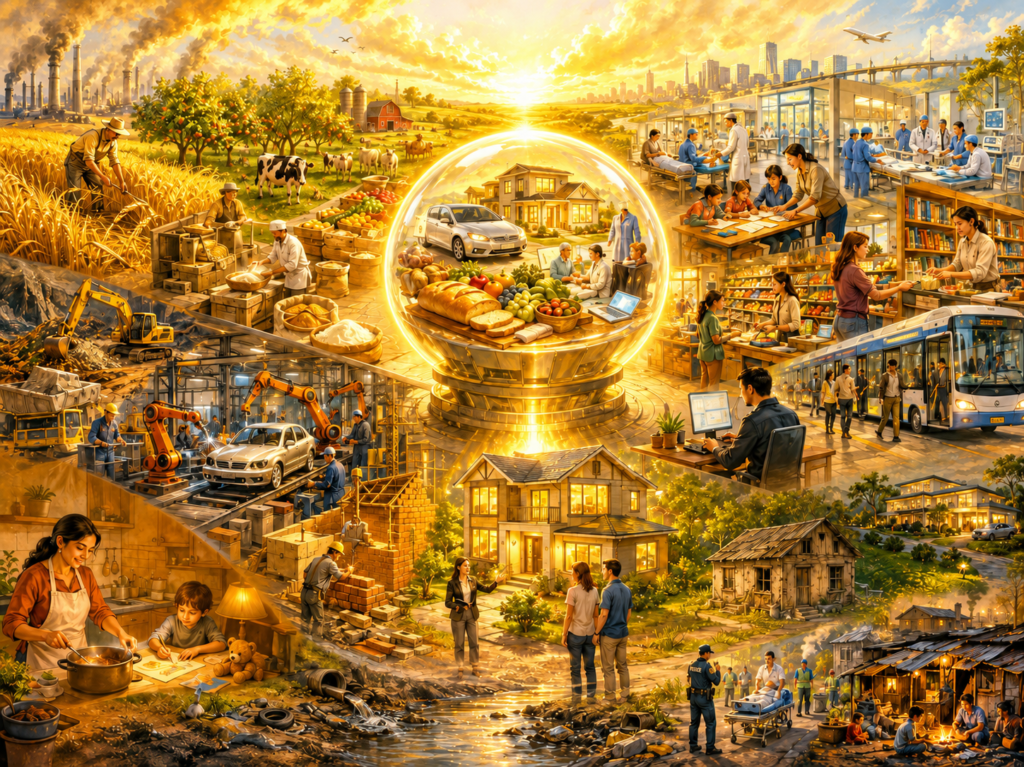

How to measure GDP is one of the most important questions in economics because Gross Domestic Product shows the value of final goods and services produced inside an economy during a specific period. In the United States, the Bureau of Economic Analysis defines GDP as the value of final goods and services produced in the country, without double-counting intermediate goods and services. Source: Bureau of Economic Analysis, URL: https://www.bea.gov/data/gdp/gross-domestic-product.
However, GDP does not measure everything that matters. It helps analysts understand economic growth, recessions, productivity, spending, investment and the overall size of an economy. Nevertheless, it does not fully measure well-being, inequality, environmental quality, unpaid household work or the distribution of opportunity. The OECD explains that GDP remains an important measure of economic output, but policy analysis also needs broader indicators of well-being and sustainability. Source: OECD, URL: https://www.oecd.org/en/topics/policy-issues/well-being-and-beyond-gdp.html.
For developed English-speaking countries such as the United States, the United Kingdom, Canada, Australia, New Zealand and Ireland, GDP is central to public debate. Governments use it to design budgets. Central banks watch it when evaluating the strength of demand. Businesses use it to plan investment. Meanwhile, households often hear GDP discussed when the media talks about recessions, inflation, wages and living standards.
What Is GDP?
GDP stands for Gross Domestic Product. It measures the market value of final goods and services produced within a country’s economic territory. Therefore, a foreign-owned car factory operating in the United States contributes to U.S. GDP, because production happens inside the United States. Similarly, a Canadian-owned company operating in London contributes to UK GDP when it produces goods or services in the United Kingdom.
The word “gross” means that GDP does not subtract the depreciation of fixed capital, such as machinery, buildings, roads, computers and equipment. The World Bank notes that GDP is calculated without deducting depreciation of produced assets or depletion and degradation of natural resources. Source: World Bank, URL: https://databank.worldbank.org/metadataglossary/jobs/series/NY.GDP.MKTP.KD.ZG.
The word “domestic” means that GDP focuses on production inside the country, not on the nationality of the company or worker. In contrast, income measures such as Gross National Income focus more on income received by residents. As a result, GDP answers one main question: how much did the economy produce within its borders?
Why GDP Matters
GDP matters because it gives a broad picture of economic activity. When real GDP grows, the economy produces more goods and services after adjusting for price changes. When real GDP falls, total production declines. Consequently, GDP helps economists identify expansion, slowdown, recession and recovery.
The UK Office for National Statistics states that GDP measures the value of goods and services produced in the UK and estimates the size and growth of the economy. Source: Office for National Statistics, URL: https://www.ons.gov.uk/economy/grossdomesticproductgdp.
In practical terms, GDP helps answer several questions. Is the economy growing? Are households spending more? Are businesses investing? Is government spending supporting demand? Are exports helping the country sell more abroad? Although GDP cannot answer all economic questions, it gives analysts a common starting point.
Moreover, GDP connects with employment, tax revenue, interest rates, business confidence, public services and living standards. A growing economy can create more opportunities, but growth alone does not guarantee that people feel better off. For that reason, GDP should be read together with inflation, wages, unemployment, productivity, inequality and environmental indicators.
How to Measure GDP
To understand how to measure GDP, it is useful to know the three main approaches used in national accounts: the production approach, the expenditure approach and the income approach. In theory, all three approaches measure the same economy from different angles.
The System of National Accounts 2008 provides the international framework used by statistical agencies around the world. It offers a comprehensive and consistent set of macroeconomic accounts for policy, analysis and research. Source: United Nations, URL: https://unstats.un.org/unsd/nationalaccount/sna2008.asp.
Therefore, developed English-speaking countries follow broadly comparable principles. The United States relies on the Bureau of Economic Analysis. The United Kingdom uses the Office for National Statistics. Canada uses Statistics Canada. Australia uses the Australian Bureau of Statistics. New Zealand uses Stats NZ. Ireland uses the Central Statistics Office. Although each country has its own data sources and publication schedule, the basic accounting logic remains similar.
The Production Approach to GDP
The production approach measures GDP by adding the value created by industries. This method focuses on output minus intermediate consumption. In other words, it measures how much value each sector adds to the economy.
The basic formula is:
GDP = Gross Value Added + Taxes on Products – Subsidies on Products
The Australian Bureau of Statistics explains that gross value added is the difference between output and intermediate consumption for each institutional unit. It also states that this approach measures the value created by production. Source: Australian Bureau of Statistics, URL: https://www.abs.gov.au/statistics/detailed-methodology-information/concepts-sources-methods/australian-system-national-accounts-concepts-sources-and-methods/2020-21/chapter-8-gross-domestic-product/measures-gdp.
This approach is useful because it shows which industries drive growth. For example, the United States often looks at services, manufacturing, construction, technology, healthcare and energy. The United Kingdom tracks services, production, construction and agriculture. Canada pays close attention to energy, finance, real estate, manufacturing, public services and trade. Australia often watches mining, construction, services, agriculture and exports. New Zealand follows sectors such as agriculture, tourism, construction and services.
The Expenditure Approach to GDP
The expenditure approach measures GDP from the demand side. It asks who bought the final goods and services produced by the economy. This method is probably the best-known GDP formula because it appears in many economics textbooks.
The formula is:
GDP = C + I + G + (X – M)
In this formula:
C means household consumption.
I means investment, also called gross private domestic investment or gross capital formation.
G means government consumption and investment.
X means exports.
M means imports.
Therefore, GDP rises when households consume more domestically produced goods and services, businesses invest more, governments buy more goods and services, or exports increase. However, imports are subtracted because they represent production from other countries.
The BEA explains that the expenditure approach measures GDP as the sum of domestically produced goods and services sold to final users, using the textbook formula C + I + G + X – M. Source: Bureau of Economic Analysis, URL: https://www.bea.gov/news/blog/2025-06-03/expenditures-approach-measuring-gdp.
This method is especially useful in developed economies because household consumption often represents a large share of demand. Nevertheless, the source of growth matters. A country can grow because households spend more, because businesses invest in new equipment, because exports rise, or because government spending increases. Each source tells a different economic story.
The Income Approach to GDP
The income approach measures GDP by adding the income generated during production. If an economy produces goods and services, that production creates wages, profits, rents, mixed income and taxes. Therefore, the income approach looks at who earns income from production.
A simplified formula is:
GDP = Compensation of Employees + Gross Operating Surplus + Gross Mixed Income + Taxes Less Subsidies on Production and Imports
Statistics Canada explains that its National Gross Domestic Product by Income and by Expenditure Accounts give a comprehensive statistical picture of Canadian economic developments. Source: Statistics Canada, URL: https://www.statcan.gc.ca/imdb-bmdi/1901-eng.htm.
The income approach is useful because it shows how production turns into income. For example, it can help analysts study the wage share of GDP, corporate profits, self-employment income and the role of taxes. In a developed economy, this matters because GDP growth can look strong even when wage growth feels weak for many households.
Why Final Goods and Services Matter
GDP counts final goods and services to avoid double-counting. Intermediate goods do not enter GDP separately when they are used to produce another good or service. Instead, GDP counts the value added at each production stage or the final product sold to the final user.
Consider bread. A farmer grows wheat. A mill turns wheat into flour. A bakery turns flour into bread. If GDP added the full value of wheat, flour and bread, it would count the same production chain more than once. Therefore, national accountants use value added.
The BEA emphasizes that GDP measures final goods and services without double-counting intermediate goods and services used up to produce them. Source: Bureau of Economic Analysis, URL: https://www.bea.gov/data/gdp/gross-domestic-product.
The same idea applies to cars, homes, computers and restaurant meals. A tire sold to a car manufacturer is an intermediate good. The car sold to a household is a final good. However, if a consumer buys replacement tires for personal use, those tires count as final goods because they go directly to the final user.
What Is Value Added?
Value added is the value a business adds to goods and services during production. It equals the value of output minus the cost of intermediate inputs purchased from other businesses.
Imagine a simple example:
A farmer sells wheat for $100.
A mill sells flour for $160 after buying wheat for $100.
A bakery sells bread for $250 after buying flour for $160.
In this case, the farmer adds $100. The mill adds $60. The bakery adds $90. Together, the value added equals $250, which matches the final value of the bread.
This logic explains why the production approach works. It captures each stage of production without counting the same input repeatedly. As a result, value added helps economists understand the contribution of agriculture, manufacturing, construction, healthcare, finance, education, technology, retail, transportation and other industries.
Current Production: GDP Measures New Output
GDP measures production during a specific period. It does not measure the total stock of wealth. Therefore, a new house built this year enters this year’s GDP. By contrast, an existing house sold from one owner to another does not count as new production.
However, the services involved in the sale can count. Real estate commissions, legal services, inspections and financial services represent current production. Therefore, the old house itself does not add to GDP again, but the services used in the transaction can add to GDP.
This distinction matters in developed English-speaking countries because housing markets often attract major public attention. Rising home sales can move large amounts of money, but GDP counts new production and current services, not the resale value of existing assets.
Nominal GDP
Nominal GDP measures output using current prices. It shows the value of production in the prices of the period being measured. Therefore, nominal GDP can rise because the economy produces more, because prices rise, or because both happen at the same time.
Nominal GDP is useful for measuring the size of the economy in current dollars, pounds, euros, Canadian dollars, Australian dollars or New Zealand dollars. Governments often compare public debt, tax revenue and budget deficits to nominal GDP. Businesses may also use nominal GDP when analyzing market size.
However, nominal GDP can mislead readers when inflation is high. If prices rise quickly, nominal GDP may increase even when real production barely changes. For that reason, economists use real GDP to measure growth in actual output.
Real GDP
Real GDP adjusts for inflation. It measures changes in the volume of production, not just changes in prices. Therefore, real GDP provides a better measure of economic growth over time.
The UK Office for National Statistics publishes current and constant price GDP data to indicate economic performance. Source: Office for National Statistics, URL: https://www.ons.gov.uk/economy/grossdomesticproductgdp.
New Zealand also publishes GDP using production, expenditure and income approaches, and Stats NZ explains that the production approach measures the total value of goods and services produced after removing the cost of goods and services used in production. Source: Stats NZ, URL: https://www.stats.govt.nz/topics/gross-domestic-product/.
Real GDP is especially important when comparing different years. If a country’s nominal GDP rises by 6% but prices rise by 5%, real GDP growth is much smaller. Consequently, real GDP helps separate genuine production growth from inflation.
GDP Deflator
The GDP deflator measures price changes for all final goods and services included in GDP. It differs from the Consumer Price Index because it covers the prices of domestically produced final output, not only a basket of consumer goods and services.
The simplified formula is:
GDP Deflator = Nominal GDP / Real GDP x 100
This measure helps analysts understand how much of nominal GDP growth comes from price changes. For example, if nominal GDP rises strongly but real GDP grows slowly, prices explain much of the difference. Therefore, the GDP deflator is useful when studying inflation from the perspective of domestic production.
GDP Per Capita
GDP per capita divides GDP by population. It gives an average level of output or income per person. However, it does not show how income is distributed.
The formula is:
GDP per capita = GDP / Population
This measure helps compare countries with different population sizes. The United States has a much larger total GDP than New Zealand or Ireland because it has a much larger population. Nevertheless, GDP per capita gives another perspective by showing average output per person.
Even so, GDP per capita has limits. A country can have high GDP per capita and still have major inequality, housing affordability problems, regional gaps or weak access to services. Therefore, it should be used with wage data, household income, poverty rates, cost-of-living measures and inequality indicators.
GDP at Purchasing Power Parity
GDP at purchasing power parity, or PPP, adjusts for differences in price levels across countries. It asks how much goods and services people can buy in each country, rather than only converting output using market exchange rates.
This matters when comparing developed English-speaking economies. Prices differ across the United States, the United Kingdom, Canada, Australia, New Zealand and Ireland. Housing, healthcare, transportation, education and food costs can vary significantly. Therefore, PPP can improve international comparisons of living standards.
However, PPP does not solve every problem. It cannot fully capture public service quality, environmental conditions, commute times, housing affordability, regional inequality or job security. As a result, PPP improves one part of comparison, but it does not replace broader analysis.
Quarterly GDP and Annual GDP
GDP is usually published quarterly and annually in developed economies. Quarterly GDP helps analysts monitor short-term economic changes. Annual GDP gives a more complete picture of the full year.
The United States publishes GDP through the Bureau of Economic Analysis. The United Kingdom publishes GDP through the Office for National Statistics. Canada publishes GDP through Statistics Canada. Australia publishes GDP through the Australian Bureau of Statistics. New Zealand publishes GDP through Stats NZ. Ireland publishes GDP through the Central Statistics Office.
The Central Statistics Office of Ireland explains that quarterly national accounts show the growth of the economy over a three-month period, while annual national accounts show yearly figures. Source: CSO Ireland, URL: https://www.cso.ie/en/interactivezone/statisticsexplained/nationalaccountsexplained/annualnationalaccountsformerlynationalincomeandexpenditure/.
Quarterly data can be revised as more information arrives. Therefore, early GDP estimates should not be treated as perfect. In many countries, statistical agencies publish initial, revised and final estimates as surveys, tax records and business reports become more complete.
How GDP Is Measured in the United States
In the United States, the Bureau of Economic Analysis produces GDP estimates. The BEA describes GDP as a comprehensive measure of U.S. economic activity and the value of final goods and services produced in the United States. Source: Bureau of Economic Analysis, URL: https://www.bea.gov/data/gdp/gross-domestic-product.
The expenditure approach often dominates public discussion in the United States. Analysts frequently look at personal consumption expenditures, private investment, government spending, exports and imports. Because consumer spending is a major part of the U.S. economy, changes in household demand receive close attention.
However, the BEA also studies value added by industry. This allows analysts to see whether growth comes from manufacturing, services, information technology, healthcare, finance, energy, construction or other sectors.
How GDP Is Measured in the United Kingdom
The United Kingdom measures GDP through the Office for National Statistics. The ONS explains that GDP measures the value of goods and services produced in the UK and estimates the size and growth of the economy. Source: ONS, URL: https://www.ons.gov.uk/economy/grossdomesticproductgdp.
The UK also publishes monthly GDP estimates, which receive significant attention because they give a more frequent signal of economic activity. Nevertheless, monthly GDP can be volatile. Therefore, analysts often compare monthly data with quarterly and annual trends.
Services play a major role in the UK economy. As a result, changes in finance, professional services, retail, hospitality, health, education and public administration can strongly influence the overall GDP picture.
How GDP Is Measured in Canada
Canada measures GDP through Statistics Canada. Its GDP by income and expenditure accounts provide a statistical picture of Canadian economic developments. Source: Statistics Canada, URL: https://www.statcan.gc.ca/imdb-bmdi/1901-eng.htm.
Canada’s economy has important regional and sectoral differences. Energy, finance, real estate, manufacturing, public services, trade, transportation and technology all matter. Therefore, GDP analysis in Canada often looks beyond the national headline and considers provinces, industries and trade relationships.
Moreover, Canada publishes GDP data in both current dollars and chained dollars. This helps readers distinguish between nominal changes and real changes in output.
How GDP Is Measured in Australia
Australia measures GDP through the Australian Bureau of Statistics. The ABS explains that economic production is the central concept in national accounts, and production combines labour, materials, capital assets and knowledge to create goods and services. Source: Australian Bureau of Statistics, URL: https://www.abs.gov.au/statistics/detailed-methodology-information/concepts-sources-methods/australian-system-national-accounts-concepts-sources-and-methods/edition-8/chapter-8-gross-domestic-product.
Australia often pays close attention to mining, exports, household consumption, construction, public demand and business investment. Because resource exports can strongly affect national income, analysts often study both GDP and related measures of income.
Additionally, Australia’s population growth can influence how people interpret GDP. Total GDP may grow while GDP per capita grows slowly or even declines. Therefore, per capita measures can help readers understand whether average living standards are improving.
How GDP Is Measured in New Zealand
New Zealand measures GDP through Stats NZ. Stats NZ states that it uses the production, expenditure and income approaches to calculate GDP. Source: Stats NZ, URL: https://www.stats.govt.nz/topics/gross-domestic-product/.
New Zealand’s economy includes agriculture, food exports, tourism, construction, public services, finance and technology. Because the country is relatively small and trade-exposed, global demand, commodity prices, migration, tourism and weather events can influence GDP.
Stats NZ also explains that GDP provides a snapshot of the performance of the economy and serves as New Zealand’s official measure of economic growth. Source: Stats NZ, URL: https://www.stats.govt.nz/information-releases/gross-domestic-product-december-2025-quarter/.
How GDP Is Measured in Ireland
Ireland measures GDP through the Central Statistics Office. The CSO defines GDP as a measure of the size of the economy and total economic activity in a country. Source: CSO Ireland, URL: https://www.cso.ie/en/interactivezone/statisticsexplained/nationalaccountsexplained/grossdomesticproductgdp/.
Ireland is a special case among developed English-speaking economies because multinational enterprises can strongly affect GDP. Intellectual property, contract manufacturing and profit flows can make headline GDP less reflective of domestic living standards. Consequently, Irish analysts often pay attention to modified indicators, including Modified Domestic Demand.
The CSO notes that Ireland uses all three methods to calculate annual GDP estimates and uses the output and expenditure methods for quarterly GDP. Source: CSO Ireland, URL: https://www.cso.ie/en/interactivezone/statisticsexplained/nationalaccountsexplained/grossdomesticproducthowitismeasured/.
What Counts in GDP?
GDP includes final goods and services produced during the period. Examples include new homes, new cars, restaurant meals, medical services, education services, transportation, financial services, software, telecommunications, energy, construction, public administration and government services.
Government services also enter GDP even when they do not have market prices. For example, public education, public healthcare, defence, policing and public administration are usually valued by their cost of production. This method allows national accounts to include important non-market production.
Investment also enters GDP. A new factory, machine, office building, data centre, software system or piece of equipment can add to GDP because it represents new production and expands future capacity.
What Does Not Count in GDP?
GDP does not count every activity with social value. Unpaid household work usually does not enter the main GDP measure. Cooking at home, caring for children, helping older relatives and cleaning one’s own home create real value, but they usually do not involve market transactions.
This creates a measurement problem. If a parent cares for a child at home, GDP does not fully capture that work. If the same family pays for childcare, GDP counts the service. Therefore, changes in labour force participation can change measured GDP even when some work simply moves from the home to the market.
GDP also excludes most sales of used goods. If one person sells a used car to another person, the car itself does not count again as new production. However, a dealer’s commission, repair service or platform fee may count as current service production.
Financial transactions alone do not directly count as production. Buying shares of a company transfers ownership of a financial asset. However, brokerage fees and financial services linked to that transaction can count because they represent services produced during the period.
GDP and the Informal Economy
Developed English-speaking countries generally have strong statistical systems, but informal activity still exists. Cash work, underreported income, informal caregiving, small side jobs and unregistered services can create real output that may not appear fully in official data.
Statistical agencies use surveys, tax records, administrative data and business reports to estimate economic activity. Even so, some areas remain difficult to measure. Therefore, GDP should be understood as a carefully constructed estimate, not as a perfect count of every productive action.
This point matters for debates about gig work, platform labour, remote work, digital services and household production. As economies change, statistical agencies must update methods to capture new types of production more accurately.
Problems with Measuring GDP
GDP is powerful, but it has limitations. It measures production, not total welfare. Therefore, a rising GDP can coexist with inequality, environmental damage, stress, poor health outcomes or declining affordability.
Unpaid Household Work
Unpaid household work remains one of the clearest limits of GDP. Families produce meals, care, cleaning, transportation and emotional support. However, GDP usually counts this work only when households buy it from the market.
This matters in developed economies where childcare, eldercare and household services are expensive. If more care work moves into paid markets, GDP can rise. Nevertheless, that does not automatically mean society became better off. It may simply mean that a previously unpaid activity became monetized.
Public Services and Quality
Public services create another challenge. Governments provide education, healthcare, defence, safety, courts, infrastructure and administration. Because many of these services do not have direct market prices, national accounts often value them by cost.
However, cost does not always equal quality. Two countries may spend similar amounts on public services but deliver different outcomes. Consequently, GDP can record government output without fully measuring effectiveness, access, timeliness or user satisfaction.
Environmental Damage
GDP does not automatically subtract environmental damage. A factory can increase output and raise GDP while polluting air or water. A mining project can add to GDP while reducing natural capital. A rebuilding effort after a natural disaster can increase measured activity even though people have suffered losses.
The World Bank’s GDP metadata notes that GDP is calculated without deductions for depletion and degradation of natural resources. Source: World Bank, URL: https://databank.worldbank.org/metadataglossary/jobs/series/NY.GDP.MKTP.KD.ZG.
Therefore, developed economies increasingly discuss climate risk, green growth, natural capital and sustainability alongside GDP. This is especially relevant for countries facing wildfires, floods, coastal risks, biodiversity loss and energy transitions.
Defensive Spending
Some spending raises GDP because it involves market activity, but it does not necessarily improve well-being. Security services, medical treatment after accidents, disaster recovery, pollution cleanup and repairs after damage can all add to GDP.
However, these activities often respond to harm. A hurricane can generate rebuilding activity, but that does not mean the disaster improved welfare. Therefore, GDP records economic activity but does not always distinguish between production that improves life and production that responds to damage.
Quality Change and Innovation
Modern economies constantly create new products. Computers become faster. Phones gain better cameras. Cars add safety features. Medical technology improves. Software replaces older processes. Artificial intelligence tools change business workflows.
Statistical agencies try to adjust for quality changes, but this is difficult. A laptop today may cost less than an older laptop while being much more powerful. Therefore, price changes alone may not capture the true improvement in quality.
Digital services create another challenge. Many people use free online tools funded by advertising. These services can provide value to users, but the value does not always appear directly in GDP in the same way as a paid product.
GDP and Well-Being
GDP and well-being are related, but they are not the same. Higher GDP can support better healthcare, education, infrastructure and jobs. However, GDP alone does not show whether people feel secure, healthy, included or optimistic.
The OECD’s Beyond GDP work emphasizes that businesses, governments and societies need broader measures to understand well-being and sustainability. Source: OECD, URL: https://www.oecd.org/en/topics/policy-issues/well-being-and-beyond-gdp.html.
A country can have high GDP and still face major problems. Housing may be unaffordable. Healthcare access may vary by region. Workers may feel financially stressed. Income gains may go mainly to high-income households. Pollution may reduce quality of life. For that reason, policymakers should combine GDP with other indicators.
Indicators That Complement GDP
A complete economic picture needs more than GDP. The following indicators help explain living standards and economic quality.
GDP Per Capita
GDP per capita shows average output per person. However, it does not show distribution.
Median Household Income
Median household income helps show what a typical household earns. This can be more useful than averages when inequality is high.
Real Wages
Real wages adjust earnings for inflation. Therefore, they help show whether workers can actually buy more goods and services.
Employment and Unemployment
Employment indicators reveal whether growth creates jobs. A country can grow while some groups still struggle to find work.
Productivity
Productivity measures output per worker or per hour. Over the long run, productivity plays a major role in living standards.
Inflation
Inflation shows how prices change. Without inflation data, nominal GDP can exaggerate economic improvement.
Inequality Measures
Measures such as the Gini coefficient, income shares and poverty rates show how growth is distributed.
Environmental Indicators
Carbon emissions, air quality, water quality, biodiversity, energy use and natural capital accounts help show whether growth is sustainable.
Well-Being Measures
Life satisfaction, mental health, education quality, safety, housing affordability, commute times and social trust can help evaluate quality of life beyond production.
GDP vs GNI
GDP and GNI answer different questions. GDP measures production inside a country. GNI measures income received by residents, including income flows from abroad.
This distinction matters in developed English-speaking countries. In Ireland, for example, multinational activity can make GDP much larger or more volatile than measures of domestic income. In resource-exporting countries, foreign ownership can also create gaps between domestic production and income received by residents.
Therefore, GDP is best for asking: how much production happened inside the country? GNI is better for asking: how much income belongs to the residents of the country?
GDP vs Economic Development
Economic growth means an increase in output, usually measured by real GDP. Economic development is broader. It includes productivity, health, education, innovation, infrastructure, institutions, environmental sustainability, inclusion and quality of life.
A developed country can grow without improving life for many residents. For example, GDP can rise while housing affordability worsens or while real wages stagnate. Conversely, a country can make progress in public health, education or environmental quality even when GDP growth is moderate.
Therefore, GDP should be treated as a key economic indicator, not as a complete scorecard for society.
How to Interpret GDP Growth
To interpret GDP growth correctly, start by asking whether the figure is nominal or real. Next, check whether it is quarterly, annual, annualized or year-over-year. Then, look at the components of growth.
If household consumption drives growth, consumer confidence, wages, credit and inflation may matter. If investment drives growth, businesses may be expanding capacity. When exports lead growth, foreign demand and exchange rates may be important. If inventories explain much of the change, the growth may not continue.
Finally, compare GDP with other indicators. Strong GDP growth with high inflation may not feel good to households. Weak GDP growth with rising real wages may still improve living standards for many people. As a result, GDP analysis works best when combined with labour market, inflation, income and productivity data.
Practical Example: Expenditure Approach
Imagine a developed economy with these annual values:
Household consumption: $700 billion
Investment: $180 billion
Government spending: $250 billion
Exports: $120 billion
Imports: $150 billion
Using the expenditure formula:
GDP = C + I + G + (X – M)
GDP = 700 + 180 + 250 + (120 – 150)
GDP = $1.1 trillion
In this example, imports exceed exports, so net exports subtract from GDP. However, household consumption, investment and government spending support total output.
Practical Example: Production Approach
Now imagine an economy with these broad sectors:
Agriculture and natural resources: $100 billion in value added
Industry and construction: $300 billion in value added
Services: $600 billion in value added
Taxes on products less subsidies: $120 billion
Using the production formula:
GDP = Gross Value Added + Taxes on Products – Subsidies on Products
GDP = 100 + 300 + 600 + 120
GDP = $1.12 trillion
This example shows why services often dominate GDP in developed economies. Healthcare, education, finance, retail, technology, professional services, public administration, transportation and hospitality can represent a large share of total output.
Common Mistakes About GDP
One common mistake is confusing GDP with national wealth. GDP measures production during a period. It does not measure all homes, land, factories, infrastructure, financial assets, natural resources or human capital.
Another mistake is assuming that GDP growth automatically means everyone is better off. Growth can create jobs and income, but the benefits depend on distribution, inflation, public services, housing costs and environmental conditions.
A third mistake is comparing countries only by total GDP. The United States has a very large GDP partly because it has a large population. Smaller developed economies such as New Zealand and Ireland may have much smaller total GDP but still have high output per person.
A final mistake is ignoring inflation. Nominal GDP can rise when prices rise. Therefore, real GDP is usually better for measuring economic growth.
Why GDP Still Matters
GDP remains important because it gives a standardized measure of economic production. It helps countries compare performance over time. It also helps international organizations compare economies using common national accounting principles.
In addition, GDP connects with policy decisions. Central banks watch GDP when evaluating demand and inflation pressure. Governments use GDP when estimating tax revenue and debt ratios. Businesses use GDP trends when planning investment, hiring and expansion.
Nevertheless, GDP should not stand alone. A strong economy should produce goods and services, but it should also support broad living standards, opportunity, resilience and sustainability.
Conclusion
How to measure GDP requires more than adding up sales. A careful GDP calculation distinguishes final goods from intermediate goods, avoids double-counting, uses value added, separates nominal GDP from real GDP, focuses on current production and applies production, expenditure and income approaches.
In developed English-speaking countries, GDP remains one of the most important economic indicators. The United States, the United Kingdom, Canada, Australia, New Zealand and Ireland all use national accounts to measure production, spending and income. However, each country also faces specific interpretation issues, from housing and healthcare costs to multinational activity, trade exposure, productivity and environmental sustainability.
In short, GDP answers the question: how much did the economy produce? Yet, to answer how people live, who benefits from growth and whether progress is sustainable, analysts must go beyond GDP. Therefore, the best economic analysis combines GDP with income, employment, inflation, productivity, inequality, environmental and well-being indicators.
Reliable Sources Used
Bureau of Economic Analysis, Gross Domestic Product: https://www.bea.gov/data/gdp/gross-domestic-product
Bureau of Economic Analysis, Expenditures Approach to Measuring GDP: https://www.bea.gov/news/blog/2025-06-03/expenditures-approach-measuring-gdp
Office for National Statistics, Gross Domestic Product: https://www.ons.gov.uk/economy/grossdomesticproductgdp
Office for National Statistics, What is GDP and how do we measure it?: https://blog.ons.gov.uk/2022/12/12/what-is-gdp-and-how-do-we-measure-it/
Statistics Canada, National GDP by Income and Expenditure Accounts: https://www.statcan.gc.ca/imdb-bmdi/1901-eng.htm
Australian Bureau of Statistics, Chapter 8 Gross Domestic Product: https://www.abs.gov.au/statistics/detailed-methodology-information/concepts-sources-methods/australian-system-national-accounts-concepts-sources-and-methods/edition-8/chapter-8-gross-domestic-product
Australian Bureau of Statistics, Measures of GDP: https://www.abs.gov.au/statistics/detailed-methodology-information/concepts-sources-methods/australian-system-national-accounts-concepts-sources-and-methods/2020-21/chapter-8-gross-domestic-product/measures-gdp
Stats NZ, Gross Domestic Product: https://www.stats.govt.nz/topics/gross-domestic-product/
Stats NZ, Gross Domestic Product December 2025 Quarter: https://www.stats.govt.nz/information-releases/gross-domestic-product-december-2025-quarter/
Central Statistics Office Ireland, Gross Domestic Product: https://www.cso.ie/en/interactivezone/statisticsexplained/nationalaccountsexplained/grossdomesticproductgdp/
Central Statistics Office Ireland, How GDP Is Measured: https://www.cso.ie/en/interactivezone/statisticsexplained/nationalaccountsexplained/grossdomesticproducthowitismeasured/
Central Statistics Office Ireland, Annual National Accounts: https://www.cso.ie/en/interactivezone/statisticsexplained/nationalaccountsexplained/annualnationalaccountsformerlynationalincomeandexpenditure/
United Nations, System of National Accounts 2008: https://unstats.un.org/unsd/nationalaccount/sna2008.asp
World Bank, GDP Growth Metadata: https://databank.worldbank.org/metadataglossary/jobs/series/NY.GDP.MKTP.KD.ZG
OECD, Well-being and Beyond GDP: https://www.oecd.org/en/topics/policy-issues/well-being-and-beyond-gdp.html
OECD, GDP and Non-financial Accounts: https://www.oecd.org/en/data/datasets/gdp-and-non-financial-accounts.html