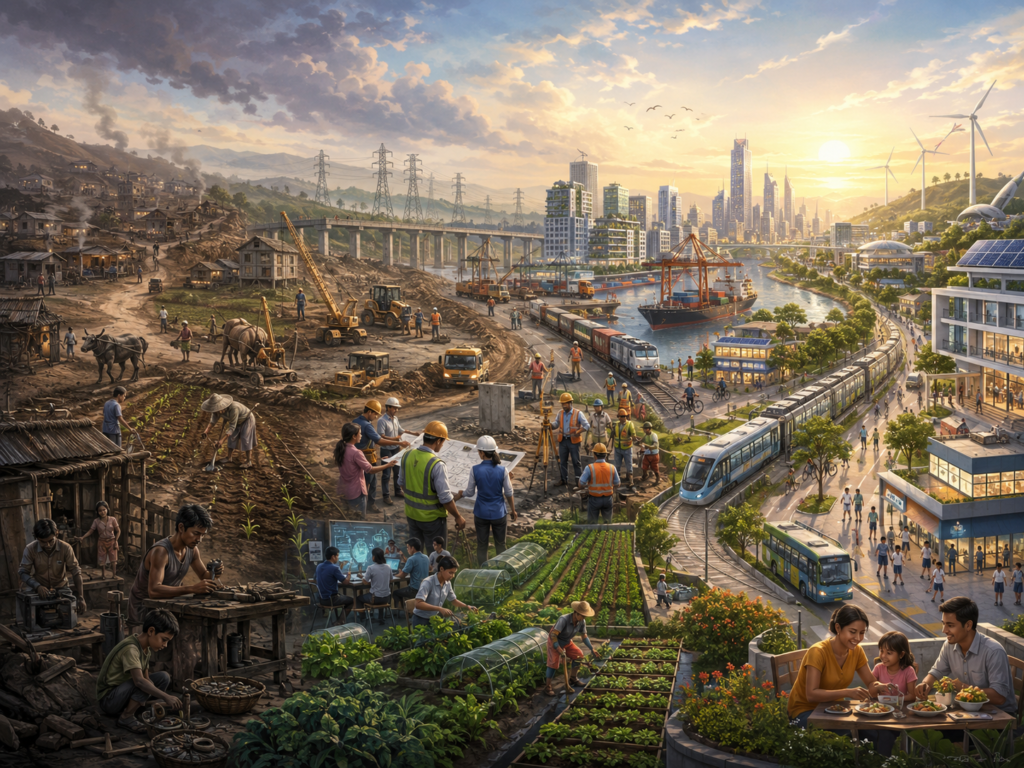

Economic growth is the increase in an economy’s ability to produce goods and services over time. In practical terms, it shows whether a country, region or society can generate more income, more jobs, more investment and better material conditions for its people.
Although the idea may sound technical, economic growth appears in everyday life. For example, when a business uses better software, when workers receive advanced training, when a city improves transport links or when a country invests in clean energy, production can increase. As a result, people may gain access to better wages, better services and more opportunities.
However, economic growth is not simply about producing more. It is also about producing better. Therefore, economists study productivity, investment, technology, education, infrastructure, institutions, trade and public policy.
In developed English-speaking countries, this topic is especially important. The United States, the United Kingdom, Canada, Australia, New Zealand and Ireland already have high living standards. Nevertheless, they still need growth to support rising wages, fund public services, adapt to aging populations, improve housing affordability, finance innovation and manage the transition to a cleaner economy.
What Is Economic Growth?
Economic growth means an increase in real economic output. Usually, economists measure it through Gross Domestic Product, or GDP. GDP represents the value of final goods and services produced within a country during a specific period.
Real GDP and inflation
According to the International Monetary Fund, GDP is one of the most common ways to measure the size and performance of an economy. However, economists usually focus on real GDP when they want to measure actual growth. Real GDP adjusts for inflation, which means it tries to show whether production increased rather than prices alone.
For example, if prices rise but the quantity of goods and services does not increase, people are not necessarily better off. Therefore, real GDP gives a clearer picture of economic growth than nominal GDP.
GDP per capita
GDP per capita divides total GDP by population. This measure is useful because it gives a rough idea of average income per person. However, it does not show how income is distributed across society.
For instance, a country can have a large economy because it has many people. Yet, if output per person is not high, living standards may remain modest. By contrast, a smaller country can have a lower total GDP but a very high GDP per capita.
Purchasing power and international comparisons
When comparing developed English-speaking countries, economists often use GDP per capita adjusted for purchasing power parity. This adjustment considers differences in prices across countries. As a result, it gives a more realistic comparison of living standards.
For example, a salary in New York, London, Toronto, Sydney or Dublin does not buy the same amount of housing, transport, food or services. Therefore, purchasing power matters when comparing income across countries.
Why Economic Growth Matters
Economic growth matters because it expands what a society can afford. When an economy becomes more productive, families can earn more, businesses can invest more and governments can finance better public services.
Higher living standards
In the long run, higher productivity is one of the main reasons people in rich countries enjoy higher living standards than previous generations. For example, many workers today have access to better homes, healthcare, transport, education, entertainment and digital services than their ancestors.
However, growth does not improve everyone’s life automatically. If income gains go mainly to a small group, many households may feel little benefit. Therefore, the quality and distribution of growth matter.
Better public services
Economic growth also helps governments fund public services. In countries such as the United Kingdom, Canada, Australia and New Zealand, public healthcare, education, pensions and infrastructure require strong tax bases. If growth slows for many years, governments may face harder choices between raising taxes, cutting services or increasing debt.
Moreover, aging populations create additional pressure. As more people retire, countries need enough productive workers and businesses to support pensions, healthcare and long-term care. Consequently, productivity growth becomes even more important.
More business opportunities
Businesses also benefit from economic growth. When households have more income, they can buy more goods and services. In addition, firms may invest in new equipment, hire more workers, expand into new markets or develop better products.
Nevertheless, growth can create disruption. Some industries expand, while others decline. Therefore, developed economies need education, retraining and flexible labor markets to help workers adapt.
Economic Growth and Living Standards
Living standards depend heavily on how much value a society can produce per person. In general, countries with higher productivity can support higher wages, better infrastructure and stronger public services.
Why developed English-speaking countries are rich
The United States, the United Kingdom, Canada, Australia, New Zealand and Ireland became high-income countries through long historical processes. In different ways, they benefited from industrialization, education, financial development, trade, technology, strong institutions and high levels of capital investment.
However, each country followed a different path. The United States built a large internal market and became a global center of technology, finance and higher education. The United Kingdom industrialized early and developed deep financial and commercial institutions. Canada and Australia combined natural resources with high human capital and modern services. New Zealand built a high-income economy with agriculture, services and strong institutions. Ireland transformed itself through education, foreign investment, technology and integration with European markets.
As a result, these countries share some features but also face different challenges.
GDP per capita is useful, but limited
GDP per capita helps compare living standards, but it does not capture everything. For example, it does not directly measure income inequality, mental health, environmental quality, unpaid work, housing affordability or social trust.
Therefore, a country can grow while many people still struggle. This is especially relevant in developed English-speaking countries, where housing costs, student debt, healthcare costs, regional inequality and job insecurity can weaken the connection between national growth and daily well-being.
Short-Term and Long-Term Economic Growth
Not all economic growth has the same meaning. Some growth comes from a temporary recovery. Other growth reflects a deeper increase in productive capacity.
Short-term growth
Short-term growth often happens when demand recovers after a recession. For example, consumers may start spending again, firms may rebuild inventories and businesses may rehire workers.
However, this kind of growth can slow once unused capacity disappears. If the economy reaches its limits without improving productivity, inflation may rise or shortages may appear. Therefore, short-term growth is helpful, but it is not enough.
Long-term growth
Long-term economic growth depends on the ability to produce more value per worker. In other words, it depends on productivity, technology, skills, investment and institutions.
For developed English-speaking countries, long-term growth is especially challenging because they already have advanced economies. Since they cannot simply copy basic technologies or build basic infrastructure from scratch, they need innovation, high-level skills and efficient systems.
Main Drivers of Economic Growth
Economic growth comes from several connected forces. Some are visible, such as machines, buildings and roads. Others are less visible, such as knowledge, trust, legal systems and management quality.
Physical capital
Physical capital includes machines, factories, computers, transport systems, energy networks, ports, offices and digital infrastructure. With better capital, workers can produce more in less time.
For example, a warehouse using automation and data systems can process more orders than a warehouse relying only on manual labor. Likewise, a hospital with modern equipment can diagnose and treat patients more effectively.
However, capital must be used well. If a country builds infrastructure in the wrong places or invests in outdated technology, the return may be weak. Therefore, the quality of investment matters as much as the quantity.
Labor force
The labor force includes the people who work or are available to work. A country can grow when more people enter employment. However, simply adding workers does not guarantee higher income per person.
In developed countries, demographic change is a major issue. Many English-speaking economies are aging, which means a smaller share of the population may work in the future. As a result, countries need higher productivity, better training, immigration policies, family-friendly labor policies and greater participation from underused groups.
Human capital
Human capital refers to education, skills, health and experience. A healthy and educated population can learn faster, use technology better and adapt to economic change more easily.
For example, workers with strong digital skills can use artificial intelligence tools, data systems and automation more productively. Meanwhile, strong basic education helps people communicate, solve problems and move between jobs.
In addition, healthcare matters. If people are healthier, they can work more effectively, miss fewer days and enjoy better quality of life. Therefore, human capital supports both economic growth and social well-being.
Productivity
Productivity means producing more with the same resources or producing the same amount with fewer resources. It is one of the most important drivers of long-term economic growth.
The OECD measures labor productivity through GDP per hour worked. This is useful because working more hours has limits. In contrast, producing more per hour can raise wages and living standards over time.
For example, a software engineer, nurse, teacher, construction worker or factory employee can become more productive with better tools, better training, better management and better systems. Therefore, productivity is not just about technology. It also depends on organization.
Technology and innovation
Technology allows economies to produce new goods, improve services and reduce costs. In developed English-speaking countries, innovation often comes from universities, research centers, start-ups, large firms and public investment.
For example, the United States has strong technology clusters in areas such as software, biotechnology, artificial intelligence, finance and defense-related research. The United Kingdom has strengths in finance, life sciences, creative industries and higher education. Canada has growing technology hubs in Toronto, Vancouver, Montreal and Waterloo. Australia and New Zealand have opportunities in mining technology, agriculture, renewable energy, education and digital services. Ireland has become a major location for technology and pharmaceutical firms.
However, innovation does not help automatically. Workers and businesses need to adopt it. Therefore, training, competition, infrastructure and good regulation are essential.
Institutions and the Rule of Law
Institutions are the rules that shape economic behavior. They include laws, courts, property rights, contract enforcement, regulations, public administration, central banks and democratic accountability.
Why institutions matter
Strong institutions reduce uncertainty. When people trust contracts, courts and public rules, they are more willing to invest. Businesses can plan for the long term, households can save and entrepreneurs can take risks.
Moreover, institutions help reduce corruption and waste. As a result, resources can move toward productive uses rather than political favoritism or legal disputes.
Developed countries still face institutional challenges
Even rich English-speaking countries must maintain institutional quality. For example, slow planning systems can limit housing supply. Complex tax rules can discourage investment. Weak competition can protect inefficient firms. In addition, political instability can reduce business confidence.
Therefore, institutional reform remains important even in advanced economies.
Infrastructure and Economic Growth
Infrastructure connects people, businesses and markets. It includes transport, energy, water, broadband, housing, schools, hospitals and public spaces.
Transport and logistics
Good transport systems reduce the cost of moving goods and people. For example, efficient ports and railways help exporters reach global markets. Meanwhile, reliable public transport helps workers access jobs.
However, congestion can weaken growth. In cities such as London, New York, Toronto, Sydney and Dublin, housing shortages and transport pressure can reduce productivity by making it harder for people to live near good jobs.
Digital infrastructure
Digital infrastructure is now central to growth. High-speed internet, cloud computing, cybersecurity and data systems support modern businesses, remote work, education and healthcare.
Therefore, countries that improve digital access can expand economic opportunities beyond major cities. This matters for rural areas in Canada, Australia, New Zealand, the United States and parts of the United Kingdom.
Energy infrastructure
Energy also shapes growth. Modern economies need reliable, affordable and cleaner energy. As countries move away from high-carbon systems, they must invest in grids, storage, renewables, nuclear capacity where applicable and efficiency.
As a result, the energy transition is not only an environmental issue. It is also an economic growth issue.
Trade and Open Economies
Trade allows countries to specialize, access larger markets and import better inputs. For developed English-speaking countries, trade remains an important source of growth.
Small open economies
Ireland and New Zealand show how smaller economies can benefit from international markets. Since their domestic markets are limited, they need trade, foreign investment and global connections.
However, openness also creates vulnerability. External shocks, exchange-rate movements and changes in global demand can affect growth. Therefore, small open economies need resilience.
Large advanced economies
The United States has a very large domestic market, which gives it scale advantages. Nevertheless, it also benefits from global trade, international finance, immigration, research networks and foreign investment.
Canada, Australia and the United Kingdom sit between these models. They have significant domestic markets, but they also rely heavily on trade, capital flows, skilled migration and international services.
Economic Growth in the United States
The United States is one of the clearest examples of long-term economic growth driven by innovation, scale and productivity. Over time, it developed large consumer markets, deep financial markets, strong universities, advanced technology sectors and major research institutions.
Strengths of the U.S. economy
The U.S. economy benefits from entrepreneurship, venture capital, flexible labor markets, world-leading universities and large technology companies. Moreover, it has a strong ability to turn ideas into commercial products.
For example, many major innovations in software, biotechnology, aviation, entertainment and digital platforms developed in the United States. As a result, the country has often been at the frontier of productivity growth.
Challenges for future growth
However, the United States also faces challenges. Income inequality, healthcare costs, regional decline, infrastructure needs, housing affordability and political polarization can affect long-term prosperity.
Therefore, future U.S. economic growth depends not only on technology, but also on education, infrastructure, competition, social mobility and institutional trust.
Economic Growth in the United Kingdom
The United Kingdom has a long economic history. It was one of the first countries to industrialize and became a major center of finance, trade, science and higher education.
Strengths of the UK economy
Today, the UK has strengths in financial services, universities, pharmaceuticals, creative industries, professional services and technology. London remains one of the world’s major financial centers. In addition, universities such as Oxford, Cambridge and Imperial College support research and innovation.
Productivity challenges
However, the UK has faced persistent productivity challenges. Many regions outside London and the South East have lower incomes and weaker investment. Therefore, regional development, housing reform, infrastructure and skills policy are important for future growth.
Moreover, trade relationships and business investment matter. Since the UK is a highly open economy, uncertainty can affect investment decisions.
Economic Growth in Canada
Canada is a high-income economy with strong natural resources, advanced services, skilled immigration and close ties to the United States.
Strengths of the Canadian economy
Canada benefits from energy, minerals, agriculture, finance, education, technology and immigration. Moreover, cities such as Toronto, Vancouver, Montreal and Calgary play important roles in services, technology, research and trade.
Natural resources remain important. However, Canada’s long-term growth also depends on innovation, housing supply, productivity and infrastructure.
Growth challenges in Canada
Housing affordability is a major issue in several Canadian cities. In addition, productivity growth has often been a concern compared with the United States. Therefore, Canada needs investment in business innovation, infrastructure, competition and skills.
Furthermore, climate policy matters because the country has both resource-based industries and strong clean-energy potential.
Economic Growth in Australia
Australia is a developed English-speaking country with high living standards, abundant natural resources and strong links to Asia-Pacific markets.
Strengths of the Australian economy
Australia has strengths in mining, agriculture, education, tourism, finance, healthcare and professional services. In addition, its geographic position gives it access to fast-growing Asian markets.
The country also benefits from immigration and urban growth. As a result, population expansion has supported demand, housing, services and labor force growth.
Future growth priorities
However, Australia needs productivity growth beyond population growth and commodity exports. Therefore, investment in innovation, energy transition, water security, housing, transport and advanced services will matter.
Moreover, climate change creates risks for agriculture, cities and natural ecosystems. Consequently, sustainable growth is especially important.
Economic Growth in New Zealand
New Zealand is a small, developed and open economy. It has strong institutions, high living standards and important strengths in agriculture, tourism, education and services.
Strengths of New Zealand
New Zealand benefits from a strong reputation for governance, natural beauty, food exports and quality of life. In addition, its agricultural sector is highly connected to global markets.
However, distance from major markets creates costs. Therefore, digital services, high-value exports and productivity improvements are especially important.
Long-term challenges
New Zealand faces challenges related to housing affordability, infrastructure, productivity and climate adaptation. Since the country is small, it needs to use talent and capital efficiently.
As a result, future growth may depend on innovation in agriculture, clean technology, tourism, education, digital exports and regional development.
Economic Growth in Ireland
Ireland is a major example of a small advanced economy that transformed rapidly through education, foreign investment and integration with global markets.
Why Ireland grew quickly
Ireland attracted multinational firms in technology, pharmaceuticals, finance and business services. Moreover, its educated workforce, European Union membership and business-friendly environment helped support growth.
As a result, Ireland became one of the most successful high-income economies in the English-speaking world.
Risks and policy questions
However, Ireland also faces challenges. Housing pressure, infrastructure needs, dependence on multinational corporations and exposure to global tax changes can affect long-term growth.
Therefore, sustainable Irish growth requires domestic innovation, housing supply, infrastructure, skills and resilience beyond multinational activity.
Economic Growth and Inequality
Economic growth can reduce poverty and raise incomes. However, it can also increase inequality if gains concentrate among high-income households, large firms or specific regions.
Regional inequality
Many developed English-speaking countries face regional divides. For example, major cities often attract high-paying jobs, global firms and skilled workers. Meanwhile, former industrial towns or rural regions may struggle.
Therefore, regional policy matters. Better transport, broadband, education, healthcare and business support can help more places benefit from growth.
Income inequality
Income inequality can weaken social trust and reduce opportunity. If children from lower-income families cannot access good schools, safe neighborhoods or professional networks, the economy wastes talent.
As a result, inclusive growth is not only a social goal. It is also an economic strategy.
Economic Growth and the Environment
For much of modern history, economic growth relied heavily on coal, oil, gas, land use and industrial emissions. Today, however, developed economies must grow while reducing environmental damage.
Green growth
Green growth means increasing income and productivity while reducing pollution, emissions and resource waste. This requires clean energy, efficient buildings, public transport, circular economy practices and innovation.
For example, countries can invest in renewable energy, electric grids, energy storage, low-carbon industry and cleaner transport. As a result, environmental policy can also create new industries and jobs.
Climate risks
Climate change can damage economic growth through floods, fires, storms, heat, water stress and insurance costs. Australia, Canada, New Zealand, the United States and the United Kingdom all face different climate-related risks.
Therefore, adaptation is necessary. Stronger infrastructure, better land-use planning, resilient agriculture and disaster preparation can protect future growth.
Education, Savings and Technology
Economic growth also depends on choices made by households, businesses and governments. In particular, education, saving and technology shape long-term productive capacity.
Education and skills
Education raises the ability to learn, innovate and use advanced tools. Moreover, strong basic education supports communication, problem-solving and adaptability.
In developed English-speaking countries, the challenge is not only access to education. Quality, affordability and relevance also matter. Therefore, vocational training, universities, apprenticeships and lifelong learning are central to future growth.
Savings and investment
Savings can finance investment in machines, buildings, research and infrastructure. However, savings must flow into productive projects. If capital goes mainly into speculative assets or unproductive activities, growth may be weaker.
For example, excessive housing speculation can raise paper wealth without increasing productive capacity. Therefore, financial systems should support business investment, innovation and infrastructure.
Technology adoption
Technology can raise productivity, but only if firms and workers adopt it. For example, artificial intelligence may help with research, logistics, healthcare, coding, finance, education and customer service.
However, adoption requires training, data quality, cybersecurity and good management. Consequently, the benefits of technology depend on more than invention alone.
Businesses, Government and Stability
Economic growth does not depend only on workers and machines. It also needs dynamic businesses, effective government and macroeconomic stability.
Role of businesses
Businesses turn ideas, labor and capital into goods and services. They invest, hire, train, innovate and compete. Therefore, a dynamic business environment supports economic growth.
When competition is healthy, firms must improve quality, reduce costs and serve customers better. In addition, entrepreneurs create new business models and push established companies to adapt.
Role of government
Government influences economic growth through infrastructure, education, regulation, taxation, science funding, public services and macroeconomic policy.
However, government action can help or harm. Well-designed policies can reduce market failures, support opportunity and encourage investment. Poorly designed policies, by contrast, can create waste, inflation, excessive debt and uncertainty.
Economic stability
Sustained growth requires predictability. Businesses invest when they can estimate costs, demand, interest rates, inflation and future rules. Families also plan better when money keeps its value and jobs are available.
Therefore, stable inflation, credible institutions and sustainable public finances support long-term growth.
How to Measure Healthy Economic Growth
Not all growth is healthy. An economy can grow through excessive debt, asset bubbles, environmental destruction or extreme concentration of income. Therefore, a good analysis looks beyond headline GDP.
Main indicators
Real GDP shows whether total production increased. GDP per capita gives a rough measure of average income. Labor productivity shows output per hour or per worker.
Complementary indicators
In addition, investment, inflation, employment, real wages, income distribution, education, health, housing affordability and environmental sustainability complete the picture.
As a result, GDP remains important, but it should not be the only measure of progress.
Common Mistakes About Economic Growth
Several mistakes make economic growth harder to understand. Therefore, it is useful to separate them clearly.
Confusing growth with inflation
A country does not become richer just because prices rise. For that reason, economists use real GDP to measure production after adjusting for inflation.
Looking only at total GDP
A large country can have a huge GDP but a lower average income per person. Therefore, GDP per capita is essential when comparing living standards.
Ignoring productivity
More workers and more investment can help, but productivity drives long-term growth. Without efficiency, an economy eventually reaches limits.
Overvaluing natural resources
Natural resources can support growth, as Canada and Australia show. However, resources are not enough by themselves. Good institutions, innovation, infrastructure and education determine whether natural wealth becomes broad prosperity.
Assuming growth solves everything
Economic growth creates opportunities, but it does not automatically guarantee fairness, sustainability or strong public services. Therefore, complementary policies remain necessary.
How Developed English-Speaking Countries Can Support Growth
There is no single formula for economic growth. However, several strategies appear often in successful advanced economies.
Improve education and training
High-quality education strengthens future productivity. In addition, technical training, apprenticeships and lifelong learning help workers adapt to automation and artificial intelligence.
Invest in infrastructure
Transport, energy, housing, water and broadband reduce costs and connect markets. Therefore, infrastructure investment can raise productivity and quality of life.
Strengthen competition
Competitive markets push firms to innovate, lower costs and improve quality. However, when large firms face weak competition, productivity may slow. As a result, competition policy matters.
Support innovation
Research, development, entrepreneurship and technology adoption create new sources of productivity. Moreover, universities, firms and government can work together to turn ideas into useful products and services.
Maintain macroeconomic stability
Low and stable inflation, sustainable public finances and credible institutions help businesses and families make long-term decisions.
Expand housing supply
Housing matters for growth because workers need to live near jobs. If housing becomes too expensive, cities become less productive and less inclusive. Therefore, planning reform and housing investment can support growth.
Build a cleaner economy
Clean energy, efficient transport and climate adaptation can reduce environmental risk while creating new industries. Consequently, sustainability should be part of growth strategy.
The Future of Economic Growth
The future of economic growth in developed English-speaking countries will depend on technology, demographics, sustainability and institutional quality.
Technology
Artificial intelligence, biotechnology, clean energy, robotics and advanced manufacturing may raise productivity. However, benefits will depend on adoption, regulation, skills and trust.
Demographics
Aging populations will pressure pensions, healthcare and public budgets. Therefore, countries need higher productivity, better workforce participation and thoughtful immigration policies.
Sustainability
Environmental limits will shape future growth. Countries that reduce emissions while improving productivity may gain advantages in clean technology, finance, energy and advanced services.
Institutions
Finally, institutions will remain essential. Stable rules, strong education systems, effective courts, capable governments and public trust help societies invest for the long term.
Conclusion
Economic growth is one of the most important ideas in economics because it helps explain how living standards improve over time. It shows why some societies became rich, why others fell behind and what may shape future prosperity.
However, growth is not just about increasing GDP. The most valuable economic growth raises productivity, improves living standards, supports opportunity and respects environmental limits.
In developed English-speaking countries, the challenge is not simply to become rich. These countries are already high-income economies. Instead, the challenge is to sustain prosperity, make growth inclusive, adapt to new technology, manage demographic change and build cleaner economic systems.
Ultimately, an economy grows in a strong and lasting way when it transforms labor, capital, technology, knowledge and institutions into greater value. Therefore, the future of economic growth depends less on producing more at any cost and more on producing better, smarter and more sustainably.