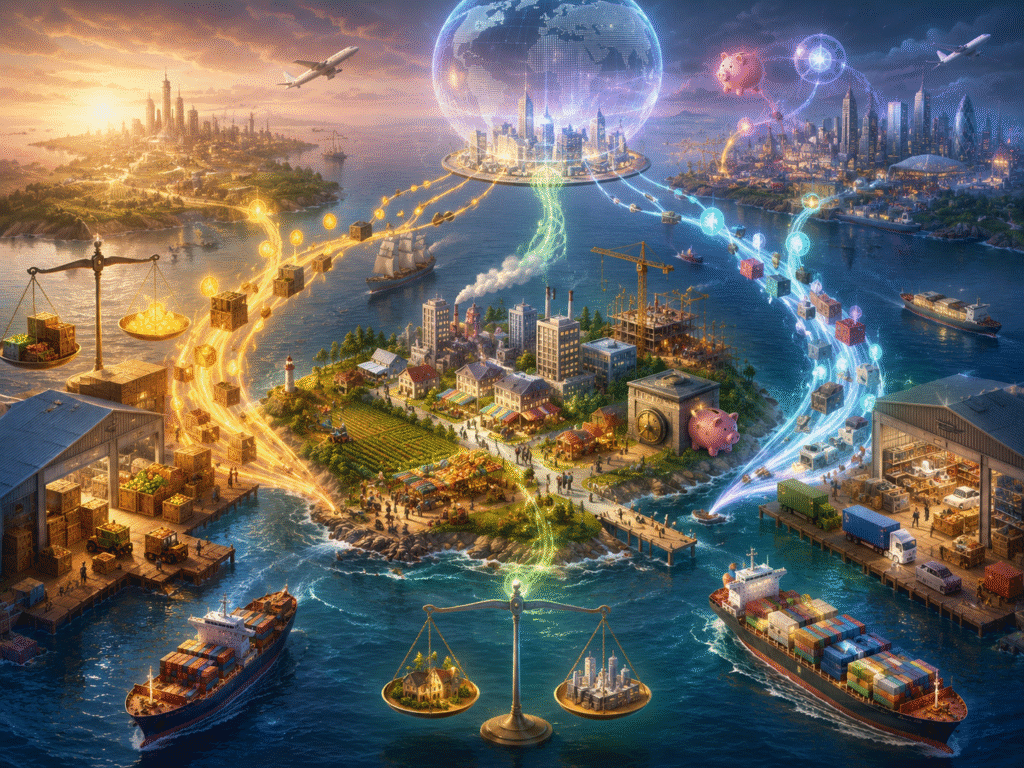

Introduction: What Is an Open Economy?
An open economy is an economy that interacts with the rest of the world through trade and financial markets. Countries buy goods and services from abroad, sell goods and services to foreign buyers, borrow from other countries, and invest internationally.
This matters because no modern economy is completely isolated. When consumers buy imported products, when companies export goods, or when investors buy foreign stocks and bonds, they are participating in the global economy.
Understanding the open economy helps explain important macroeconomic questions, such as why some countries run trade deficits, why others have trade surpluses, how international capital flows work, and how saving and investment are connected to trade.
The Difference Between a Closed Economy and an Open Economy
Closed Economy
A closed economy does not trade with other countries. In this simplified model, all output is sold domestically, and total spending is divided into three main parts:
Y = C + I + G
Where:
Y = national output or GDP
C = consumption
I = investment
G = government purchases
In a closed economy, domestic spending equals domestic production because there are no exports or imports.
Open Economy
An open economy includes international trade. Some goods produced at home are sold abroad, and some goods consumed at home are produced abroad.
Because of this, the national income identity becomes:
Y = C + I + G + NX
Where:
NX = net exports
Net exports are the difference between exports and imports:
NX = EX – IM
EX means exports, and IM means imports.
What Are Net Exports?
Net Exports Meaning
Net exports measure how much a country sells to other countries compared with how much it buys from them.
If a country exports more than it imports, net exports are positive. If it imports more than it exports, net exports are negative.
Net Exports Formula
The formula is:
NX = EX – IM
For example, if a country exports $500 billion and imports $600 billion:
NX = $500 billion – $600 billion = -$100 billion
This means the country has negative net exports.
Trade Surplus, Trade Deficit, and Balanced Trade
Trade Surplus
A trade surplus happens when exports are greater than imports.
Exports > Imports
NX > 0
This means the country is selling more goods and services to the world than it is buying from the world.
Trade Deficit
A trade deficit happens when imports are greater than exports.
Exports < Imports
NX < 0
This means the country is buying more from other countries than it is selling to them.
Balanced Trade
Balanced trade happens when exports equal imports.
Exports = Imports
NX = 0
In this case, the value of goods and services sold abroad equals the value of goods and services purchased from abroad.
Net Exports and Domestic Spending
A useful way to understand net exports is this equation:
NX = Y – (C + I + G)
This means:
Net Exports = Output – Domestic Spending
If a country produces more than it spends domestically, it exports the extra output. Net exports are positive.
If a country spends more than it produces, it imports the difference. Net exports are negative.
Example
Imagine a country produces $1 trillion in goods and services but spends only $900 billion domestically.
NX = $1 trillion – $900 billion = $100 billion
The country has a trade surplus.
Now imagine the country produces $1 trillion but spends $1.1 trillion domestically.
NX = $1 trillion – $1.1 trillion = -$100 billion
The country has a trade deficit.
International Capital Flows and the Trade Balance
What Are International Capital Flows?
International capital flows happen when money moves between countries for investment, borrowing, or lending.
For example, a person in the United States may buy stock in a Japanese company. A foreign investor may buy U.S. government bonds. A company may borrow from foreign lenders to finance a project.
These financial movements are closely connected to trade.
Net Capital Outflow
Net capital outflow measures the difference between the amount domestic residents lend or invest abroad and the amount foreigners lend or invest domestically.
In macroeconomics, net capital outflow is linked to saving and investment:
Net Capital Outflow = S – I
Where:
S = national saving
I = domestic investment
If saving is greater than investment, the extra saving flows abroad. If investment is greater than saving, the country borrows from abroad.
The Key Identity: Saving, Investment, and Net Exports
One of the most important equations in open economy macroeconomics is:
S – I = NX
This equation shows that the trade balance equals the difference between national saving and domestic investment.
When Saving Is Greater Than Investment
If:
S > I
Then:
NX > 0
The country has a trade surplus. It saves more than it invests at home, so the extra saving is invested abroad.
When Saving Is Less Than Investment
If:
S < I
Then:
NX < 0
The country has a trade deficit. It invests more than it saves, so it must borrow from abroad.
When Saving Equals Investment
If:
S = I
Then:
NX = 0
The country has balanced trade.
Why Trade Balance and Capital Flows Are Two Sides of the Same Coin
The trade balance and international capital flows are connected because every international transaction has two sides.
When a country exports more than it imports, foreign buyers must pay for those goods and services. The exporting country receives financial claims on the rest of the world. In simple terms, it lends to other countries.
When a country imports more than it exports, it must finance the extra imports. It does this by borrowing from abroad or selling assets to foreign investors.
This is why:
Trade Balance = Net Capital Outflow
Or:
NX = S – I
A trade deficit is not only about buying more goods from abroad. It also means the country is receiving capital inflows from the rest of the world.
The Irrelevance of Bilateral Trade Balances
What Is a Bilateral Trade Balance?
A bilateral trade balance measures trade between two specific countries. For example, the trade balance between the United States and China compares U.S. exports to China with U.S. imports from China.
Why Bilateral Trade Balances Can Be Misleading
A country can have a trade deficit with one country and a trade surplus with another. What matters more for macroeconomics is the country’s overall trade balance with the entire world.
For example, a country may import many goods from one trading partner but export heavily to others. Looking only at one bilateral relationship can create a misleading picture.
The national trade balance is more important because it reflects the relationship between the country’s total saving and total investment.
The Small Open Economy Model
What Is a Small Open Economy?
A small open economy is an economy that participates in world markets but is too small to affect global prices or the world interest rate.
This is a simplifying assumption used in macroeconomics. It helps economists understand how trade and capital flows work without making the model too complicated.
Perfect Capital Mobility
In the small open economy model, economists often assume perfect capital mobility. This means people and businesses can borrow and lend freely in world financial markets.
Because of this, the domestic real interest rate equals the world real interest rate:
r = r*
Where:
r = domestic real interest rate
r* = world real interest rate
The small open economy takes the world interest rate as given.
Saving and Investment in a Small Open Economy
In a small open economy, saving and investment do not need to be equal.
This is different from a closed economy, where saving must equal investment.
In an open economy:
NX = S – I
Saving depends on factors such as income, taxes, consumption, and government spending. Investment depends largely on the real interest rate.
Because the small open economy uses the world interest rate, domestic investment is influenced by global financial conditions.
How Fiscal Policy Affects the Trade Balance
Government Spending and Taxes
Fiscal policy can affect national saving. If the government increases spending or cuts taxes without reducing other spending, national saving may fall.
When national saving falls, the equation changes:
NX = S – I
If saving decreases and investment stays the same, net exports fall. This can move the country toward a trade deficit.
Example
If a government runs a budget deficit, public saving falls. Lower national saving can lead to more borrowing from abroad. This may increase capital inflows and reduce net exports.
In simple terms, lower saving can contribute to a larger trade deficit.
How the World Interest Rate Affects Investment and Trade
Higher World Interest Rate
If the world interest rate rises, borrowing becomes more expensive. Businesses may reduce investment because fewer projects are profitable.
When investment falls, the difference between saving and investment may increase:
S – I rises
As a result, net exports may rise.
Lower World Interest Rate
If the world interest rate falls, borrowing becomes cheaper. Businesses may increase investment.
When investment rises, the difference between saving and investment may decrease:
S – I falls
As a result, net exports may fall.
Why Open Economy Macroeconomics Matters
Understanding the open economy is important because it connects domestic decisions with global outcomes.
It helps explain:
International Trade Patterns
Countries do not only trade because of consumer preferences. Their trade balances also reflect saving, investment, and capital flows.
Government Policy Effects
Fiscal policy can affect more than domestic output. It can also affect trade deficits, trade surpluses, and international borrowing.
Global Financial Connections
Interest rates, investment decisions, and capital flows connect countries. A change in one part of the world can influence borrowing, lending, and investment elsewhere.
Economic Interpretation of Trade Deficits
A trade deficit is not automatically good or bad. It can mean a country is borrowing to finance productive investment, or it can mean the country is consuming more than it produces. The meaning depends on the broader economic context.
Conclusion: The Open Economy in Simple Terms
An open economy is connected to the rest of the world through goods, services, and financial markets. The key idea is that trade and capital flows are linked.
The most important identity is:
S – I = NX
This means a country’s trade balance depends on the difference between national saving and domestic investment.
If saving is greater than investment, the country usually has a trade surplus and lends abroad. If investment is greater than saving, the country usually has a trade deficit and borrows from abroad.
By understanding net exports, trade balance, capital flows, and the small open economy model, students can better understand how modern economies interact in a globalized world.