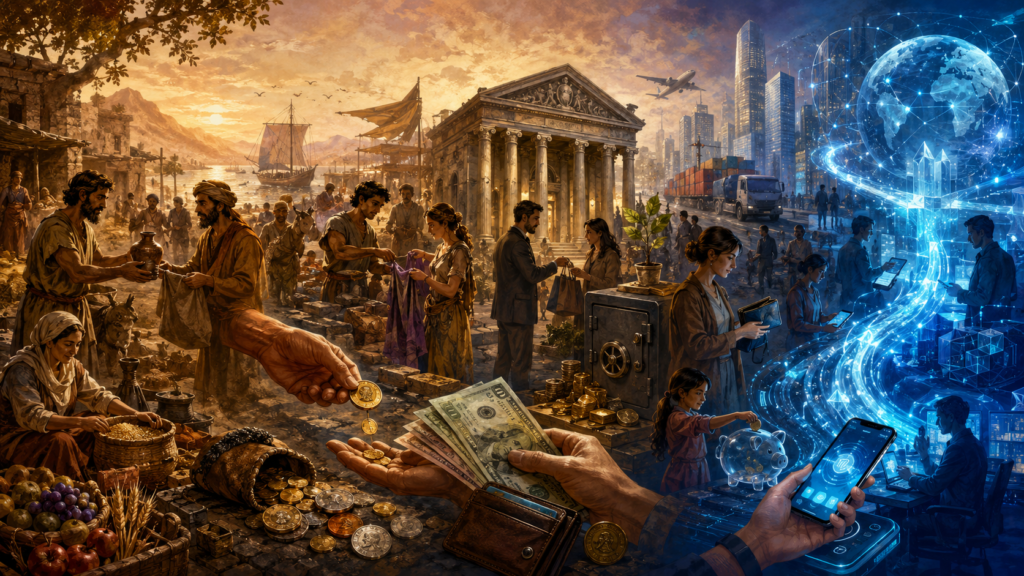

The definition of money goes far beyond banknotes, coins, or numbers in a bank account. In economics, money is any widely accepted instrument used to pay for goods, purchase services, settle debts, compare prices, and store value. Therefore, money helps people trade, organize economic decisions, save purchasing power, and plan for the future.
Moreover, money appears in almost every part of daily life. A person uses it to buy groceries, pay rent, receive wages, make investments, save for emergencies, repay loans, or send payments online. However, even though money feels familiar, its economic meaning is deeper than it first appears.
In simple terms, money is whatever a society accepts as payment. Nevertheless, that acceptance depends on trust. A dollar bill, a pound coin, or a digital bank balance has value because people, businesses, banks, and governments recognize it as useful in transactions. As a result, money works not only as an object, but also as a social agreement.
According to the Bank of England, money is a way of representing value. It can appear as banknotes, coins, bank deposits, cheques, and electronic payments.
Reference: Bank of England, “What is money?”
https://www.bankofengland.co.uk/explainers/what-is-money
Likewise, the Federal Reserve explains that the money supply includes cash, coins, and balances in bank accounts that households and businesses use to make payments or hold as short-term investments.
Reference: Federal Reserve, “What is the money supply?”
https://www.federalreserve.gov/faqs/money_12845.htm
What Is Money?
In economic terms, money is a tool that makes exchange easier. Instead of directly trading one product for another, people use a generally accepted currency. Therefore, money removes the need to find someone who has exactly what you want and, at the same time, wants exactly what you offer.
Before money became common, many societies relied on barter. In a barter system, one person exchanged goods directly with another person. For example, a farmer might try to trade wheat for shoes, tools, or clothing. However, this system had a serious limitation: both people had to want what the other person offered.
This problem is known as the double coincidence of wants. For an exchange to happen, the wheat farmer needed to find a shoemaker who wanted wheat. If that match did not exist, the trade could not happen. In contrast, money makes the process much easier.
After selling wheat, the farmer can receive money and use it later to buy shoes from any seller who accepts that currency. As a result, money acts as a bridge between buyers and sellers. Additionally, it allows prices to be compared clearly.
For example, if a shirt costs a certain amount of dollars, pounds, Canadian dollars, Australian dollars, New Zealand dollars, or euros, consumers can compare that price with the cost of a meal, a book, or a train ticket. Consequently, money helps organize decisions that would otherwise require complex negotiations.
In summary, money is a social technology. It is not only paper, metal, or a digital number. In practice, it represents trust, acceptance, and economic coordination.
Definition of Money in Economics
Economists usually define money by the functions it performs. This approach is useful because money has taken many forms throughout history. For example, societies have used shells, cattle, tobacco, gold, silver, paper notes, coins, checks, bank deposits, and digital records as money.
Therefore, the main question is not only “What is money made of?” The more important question is “What does money do in the economy?” Because of this, the definition of money should focus on its practical role rather than only its physical form.
According to the functional definition, money has three main roles. First, it serves as a medium of exchange. Second, it works as a unit of account. Third, it acts as a store of value.
Additionally, many economists mention a fourth function: money works as a standard of deferred payment. This function appears in mortgages, car loans, leases, wages, business contracts, insurance policies, and credit agreements. For instance, when someone buys a home with a mortgage in the United States, Canada, the United Kingdom, Australia, New Zealand, or Ireland, future payments are expressed in a specific currency.
The Reserve Bank of Australia also explains that money has taken diverse forms across history, from shells and gold coins to paper notes, polymer banknotes, and digital bank records.
Reference: Reserve Bank of Australia, “What is Money?”
https://www.rba.gov.au/education/resources/explainers/what-is-money.html
Why Money Exists
Money exists because societies needed a more efficient way to exchange goods and services. As economies grew, barter became less practical. After all, an economy with millions of products, services, jobs, contracts, and financial obligations cannot depend only on direct exchange.
First, money reduces the time needed to make transactions. Second, it makes values easier to divide. Moreover, it allows people to receive income today and spend or save it later. As a result, markets can operate with more speed, scale, and organization.
Imagine a modern city without money. A teacher would need to trade lessons for food, transportation, housing, clothing, electricity, and internet service. Meanwhile, a doctor would need to find patients who could offer the exact goods or services needed in return. Furthermore, a supermarket would have to accept all kinds of goods instead of standardized payment.
Very quickly, trade would become slow, confusing, and expensive. With a widely accepted currency, however, each person can specialize in one activity, receive payment for work, and then use that income to buy what they need. Therefore, money supports specialization, productivity, and economic growth.
Money in Developed English-Speaking Countries
National currencies and monetary systems
In developed English-speaking countries, money performs the same basic economic functions, but each country has its own monetary system. The United States uses the U.S. dollar. The United Kingdom uses the pound sterling. Canada uses the Canadian dollar. Australia uses the Australian dollar. New Zealand uses the New Zealand dollar. Ireland, however, uses the euro because it is part of the euro area.
Although these countries have different currencies, they share several common features. They have advanced banking systems, central banks, electronic payment networks, consumer credit markets, financial regulation, and high levels of digital payment adoption. Therefore, money in these economies is not limited to physical cash.
The Central Bank of Ireland explains that the euro is the official currency used by 21 European Union member states and that the Central Bank of Ireland is responsible for issuing euro notes and coins in Ireland.
Reference: Central Bank of Ireland, “Banknotes & Coins”
https://www.centralbank.ie/consumer-hub/notes-and-coins
Cash, bank deposits, and digital payments
In countries such as the United States, the United Kingdom, Canada, Australia, and New Zealand, much of daily money use happens through bank accounts and electronic payments. For example, people commonly use debit cards, credit cards, mobile wallets, bank transfers, direct deposits, and online bill payments.
Nevertheless, cash still matters. It remains useful for small purchases, emergencies, privacy, and financial inclusion. Additionally, physical money can be important during power outages, technology failures, natural disasters, or situations where digital systems are unavailable.
The Reserve Bank of New Zealand states that it aims to keep prices stable, maintain cash supplies, and protect the stability of New Zealand’s financial system.
Reference: Reserve Bank of New Zealand
https://www.rbnz.govt.nz/
Inflation and purchasing power
In developed English-speaking economies, central banks pay close attention to inflation because inflation affects the purchasing power of money. When prices rise, the same amount of money buys fewer goods and services. Consequently, people may feel that wages, savings, and pensions do not stretch as far as before.
For example, the Bank of Canada explains that the Consumer Price Index is widely used as an indicator of inflation and that changes in prices affect the purchasing power of money.
Reference: Bank of Canada, “Consumer Price Index”
https://www.bankofcanada.ca/rates/price-indexes/cpi/
Because of this, central banks use monetary policy to influence interest rates, credit conditions, inflation, and economic activity. In the United States, the Federal Reserve conducts monetary policy to promote maximum employment, stable prices, and moderate long-term interest rates.
Reference: Federal Reserve, “Monetary Policy”
https://www.federalreserve.gov/monetarypolicy.htm
Historical Origin of Money
The history of money began long before modern banknotes. In ancient societies, certain goods became accepted as payment because they had social value, practical usefulness, or scarcity. For example, people used shells, cattle, salt, tobacco, metal, grain, and precious metals in different places and periods.
Over time, precious metals became especially important. Gold and silver were durable, divisible, relatively scarce, and widely valued. Therefore, they became major forms of commodity money.
Later, governments and political authorities began minting standardized coins. This process increased confidence in trade because coins had recognized weight, shape, and value. Moreover, standardization reduced the need to test every piece of metal during each transaction.
In English-speaking countries, monetary history also includes colonial trade, gold and silver coins, private banknotes, central banking, the gold standard, and the later rise of fiat money. In the United Kingdom, for example, the Bank of England notes that banknotes were once convertible into gold, but that link ended in 1931. Since then, banknotes have functioned as fiat money.
Reference: Bank of England, “What is money?”
https://www.bankofengland.co.uk/explainers/what-is-money
This history shows that money changes over time. Nevertheless, its core purpose remains similar: to facilitate exchange, measure value, and organize economic life.
Main Functions of Money
The definition of money becomes clearer when we analyze its functions. Although money can appear in different forms, it must perform certain roles to work effectively. Therefore, these functions explain why money is essential in every modern economy.
Medium of exchange
The most familiar function of money is serving as a medium of exchange. This means money allows people to buy and sell goods and services easily. Instead of directly exchanging goods, people use currency to complete transactions.
By reducing costs and saving time, this function increases market efficiency. Additionally, it allows each person to earn income from work and use that income in many different places. For example, a worker in the United States may receive wages in dollars and use that money to pay rent, buy groceries, purchase gas, repay loans, and save for retirement.
Similarly, a worker in the United Kingdom may receive pounds and use them to cover transportation, housing, food, and utilities. Without a common medium of exchange, each purchase would require direct negotiation. With money, however, the process becomes simpler.
A seller does not need to want a specific good from the buyer. Instead, the seller only needs to accept payment. Consequently, money expands the number of possible exchanges, and modern economies depend on this function at a large scale.
Unit of account
Another essential function of money is serving as a unit of account. In other words, money allows people to measure and compare prices. When a society uses a common currency, it becomes easier to calculate costs, profits, wages, taxes, debts, and investments.
A business can compare the price of machinery, rent, electricity, wages, software, raw materials, and transportation because all these costs are expressed in a common monetary unit. Likewise, a household can build a budget when income and expenses are recorded in dollars, pounds, euros, or other national currencies.
Moreover, the unit-of-account function makes prices more transparent. Consumers can compare options more easily, while businesses can plan production and investment. Consequently, money helps coordinate decisions across the economy.
Store of value
Money also functions as a store of value. This means it allows people to transfer purchasing power from the present to the future. When someone saves part of their income, they expect to use that value later to buy goods and services.
However, this function depends on price stability. If inflation is high, money loses purchasing power quickly. In that case, people may look for other ways to protect wealth, such as savings accounts, bonds, property, stocks, inflation-linked securities, or foreign currency.
In developed economies, this function matters for retirement planning, emergency savings, pensions, mortgages, insurance, and long-term contracts. Therefore, stable money supports confidence in the future.
Standard of deferred payment
Money also works as a standard of deferred payment. This function appears when contracts set future payments in a specific currency.
Mortgages, student loans, car loans, leases, insurance policies, wages, and business contracts all depend on this function. For example, a mortgage in Canada may require monthly payments in Canadian dollars for many years. Likewise, a home loan in Australia may require future payments in Australian dollars.
This function requires trust. If money loses value rapidly, long-term contracts become riskier. Therefore, stable currency and credible institutions are especially important for credit markets, housing finance, business planning, and government debt.
Characteristics of Good Money
The quality of money depends on several characteristics. Therefore, not every object works well as money. To perform its functions effectively, money should have acceptance, durability, divisibility, portability, relative scarcity, uniformity, and security.
General acceptance
Acceptance is the most important characteristic of money. An object, note, coin, or digital record works as money only if people accept it as payment. For this reason, social trust is essential.
This acceptance can come from tradition, law, financial institutions, central banks, and public confidence. In modern economies, governments usually require taxes to be paid in the official currency, which strengthens demand for that currency. Nevertheless, public confidence remains necessary.
Durability
Good money should last. If something deteriorates quickly, it does not work well as a store of value. Therefore, perishable goods such as food are not ideal forms of money in complex economies.
Banknotes, coins, and digital records are more durable. However, each form has risks. On one hand, paper or polymer banknotes can be damaged. On the other hand, coins can wear down over time. Likewise, digital money depends on secure technology.
Divisibility
Divisibility allows money to support payments of different sizes. A useful currency must work for both small purchases and large transactions. Additionally, divisibility helps create more precise prices.
For example, the U.S. dollar, Canadian dollar, Australian dollar, New Zealand dollar, pound sterling, and euro all have smaller units or accounting systems that allow prices to be expressed in detail. As a result, people can buy inexpensive items, pay exact bills, and compare prices more easily.
Portability
Portability means money should be easy to carry, store, and transfer. Precious metals had value, but large amounts could be heavy and inconvenient. In contrast, digital money can move quickly between accounts, cities, and countries.
However, this advantage also creates security needs. The easier money is to move, the more important it becomes to protect passwords, bank accounts, cards, mobile wallets, payment apps, and personal data.
Relative scarcity
Money needs controlled supply. If anyone could create money without limits, its value would decline rapidly. For that reason, modern economies use central banks, banking regulation, and monetary policy to help manage money and credit.
In the United States, the Federal Reserve explains that the money supply includes cash, coins, and balances in bank accounts. Moreover, many measures of money include safe assets that households and businesses can use for payments or short-term investment.
Reference: Federal Reserve, “What is the money supply?”
https://www.federalreserve.gov/faqs/money_12845.htm
Uniformity
Good money should be standardized. A $20 bill should represent the same nominal value as another $20 bill. Likewise, a £50 balance in one bank account should represent the same nominal amount as £50 in another account within the same monetary system.
Because of this uniformity, buyers and sellers can trade with more confidence. Additionally, commerce becomes faster because people do not need to evaluate every unit of money individually.
Security against counterfeiting and fraud
Security is also essential. If counterfeiting spreads, confidence in currency declines. Therefore, modern banknotes include security features such as watermarks, special inks, raised printing, transparent windows, holograms, or polymer materials.
In digital systems, however, the challenge changes. It is not only about counterfeit banknotes. It is also about protecting accounts, transfers, payment cards, online banking, and mobile apps. Therefore, monetary security includes both the physical and digital worlds.
Types of Money
Money can appear in different forms. Each type emerged in a specific historical, technological, or institutional context. Although all types can support payments, they do not work in exactly the same way.
Commodity money
Commodity money has value as a good. Throughout history, societies used salt, cattle, shells, tobacco, grain, gold, silver, and other objects as payment.
In these cases, the object had usefulness or social value outside its monetary role. Gold, for example, worked as money because it was scarce, durable, divisible, and widely valued. However, transportation and verification of weight and purity could make it difficult to use.
Metal money
Metal money appeared when authorities began minting standardized coins. This process increased confidence because coins had recognized weight, shape, and value.
Gold, silver, copper, and other metals circulated in different historical periods. With coins, trade became more predictable. Nevertheless, metal money could still suffer from wear, clipping, counterfeiting, and changes in value when metal supply changed.
Paper money
Paper money made transactions easier because it was lighter and more practical than precious metals. Initially, many banknotes represented promises to convert paper into gold or silver. Over time, however, many countries abandoned direct convertibility.
Today, most money in developed English-speaking countries is fiat money. This means it is not backed by a direct claim on gold. Instead, its value comes from trust, law, social acceptance, and institutional stability.
In the United Kingdom, the Bank of England explains that banknotes became fiat money after the gold standard ended.
Reference: Bank of England, “What is money?”
https://www.bankofengland.co.uk/explainers/what-is-money
Bank money
Bank money refers to balances recorded in bank accounts. When someone checks a balance in a banking app, that number can be used for payments, transfers, and purchases. Therefore, a large share of modern money exists as electronic records.
This form of money is essential in developed economies. For example, wages, debit cards, direct deposits, bank transfers, mortgage payments, online shopping, and automatic bill payments depend on bank deposits.
The Bank of England explains that money today includes bank deposits and electronic payments, not only cash.
Reference: Bank of England, “What is money?”
https://www.bankofengland.co.uk/explainers/what-is-money
Electronic money
Electronic money appears in online banking, mobile wallets, payment apps, prepaid cards, and digital payment systems. Its main advantage is speed. Moreover, it reduces the need to carry cash.
This type of money has grown strongly in the United States, the United Kingdom, Canada, Australia, New Zealand, and Ireland. For example, many consumers use contactless cards, mobile phone payments, online transfers, and recurring digital payments. However, electronic money depends on infrastructure.
Internet access, electricity, smartphones, secure banking systems, cybersecurity, regulation, and financial literacy are all necessary for digital money to work well. Therefore, advanced economies still need to protect people who rely on cash or have limited digital access.
Cryptocurrencies and digital assets
Cryptocurrencies are digital assets that use technologies such as blockchain to record transactions. Bitcoin is the best-known example, but there are many other cryptoassets.
Despite the name, many cryptocurrencies do not function well as money in the traditional economic sense. They can have high volatility, limited acceptance, regulatory risks, and consumer protection concerns. Therefore, in many cases, they behave more like speculative assets than everyday payment instruments.
In developed English-speaking countries, cryptoassets have influenced debates about financial innovation, payment systems, stablecoins, regulation, and consumer risk. However, it is important to distinguish official money, payment technology, private digital assets, and investments.
Central bank digital currencies
Central bank digital currencies, often called CBDCs, are possible digital forms of public money issued or controlled by central banks. They are different from private cryptocurrencies because they would represent official money.
The Bank of Canada has explored a digital Canadian dollar to be ready in case it is needed in the future.
Reference: Bank of Canada, “Digital Canadian Dollar”
https://www.bankofcanada.ca/digitaldollar/
In Ireland and other euro-area countries, the European Central Bank has studied the digital euro as a possible electronic form of central bank money that could complement cash.
Reference: European Central Bank, “Digital euro”
https://www.ecb.europa.eu/euro/digital_euro/html/index.en.html
Nevertheless, each country approaches digital public money differently. Among the main issues are privacy, security, financial inclusion, banking competition, payment efficiency, and public trust.
Difference Between Money, Currency, and Wealth
Although money, currency, and wealth are related, they do not mean the same thing. This distinction helps avoid common confusion. Additionally, it improves understanding of personal finance and investment decisions.
Money is the tool used for payment and transactions. Currency, in contrast, is the official monetary unit of a country or region, such as the U.S. dollar, pound sterling, Canadian dollar, Australian dollar, New Zealand dollar, or euro.
Wealth, on the other hand, includes the full set of assets and resources a person, business, or country owns. A family may have little cash in a checking account but own a home, retirement savings, land, stocks, or a business. Similarly, a person can earn a high income and still fail to build wealth if all income is spent quickly.
Therefore, money represents liquidity. Wealth represents net resources and assets. This distinction is essential for understanding saving, investing, inequality, and long-term financial planning.
Payment Methods and Money
It is also useful to distinguish money from payment methods. Money represents purchasing power and settles transactions. Payment methods, however, are tools used to move that value.
Cash includes banknotes and coins. Bank deposits function as money in modern economies. Additionally, debit cards, credit cards, checks, bank transfers, mobile wallets, and payment apps allow people to use or transfer money.
A debit card, for example, moves money that is already available in a bank account. In contrast, a credit card creates a future payment obligation. Therefore, credit cards make purchases easier, but they mainly work as credit instruments.
This distinction matters because not every payment method represents immediate money. In some cases, the payment method only gives access to money or creates debt.
The Value of Fiat Money
Most modern money is fiat money. This means it does not get its value from the material used to produce it. A banknote is not valuable because of paper or polymer alone. Likewise, a digital bank balance has no physical form. Nevertheless, both can work as money if society accepts them.
Trust is not automatic. It depends on institutions, price stability, legal rules, monetary policy, and social acceptance. Moreover, the fact that governments require taxes to be paid in official currency helps reinforce demand for that currency.
However, fiat money can lose value when confidence weakens. Persistent inflation, fiscal problems, political instability, banking crises, or weak institutions can reduce purchasing power.
Therefore, credibility is essential. Without trust, money cannot perform its functions effectively.
Central Banks, Money, and Inflation
How inflation affects purchasing power
Inflation is the general increase in prices over time. When inflation rises, money loses purchasing power. In other words, the same amount of money buys fewer goods and services.
For example, if a basket of groceries costs more each month, a household needs more income to maintain the same standard of living. When this process affects many goods and services, the economy experiences inflation.
Inflation can occur for several reasons. Production costs may increase. Additionally, demand may grow faster than supply. External shocks can also make food, energy, housing, or imports more expensive. Moreover, excessive growth in money and credit can add pressure to prices in some circumstances.
Central banks in developed English-speaking countries
In developed English-speaking countries, central banks play a major role in protecting the value of money. The Federal Reserve manages monetary policy in the United States. The Bank of England does so in the United Kingdom. The Bank of Canada manages Canadian monetary policy. Likewise, the Reserve Bank of Australia and the Reserve Bank of New Zealand conduct monetary policy in their countries.
In Ireland, monetary policy is part of the euro-area system led by the European Central Bank. However, the Central Bank of Ireland remains important for financial stability, bank supervision, consumer protection, and euro cash issuance in Ireland.
The Bank of Canada explains that its inflation-targeting approach is centered on a 2% target within a 1% to 3% control range.
Reference: Bank of Canada, “Monetary policy”
https://www.bankofcanada.ca/core-functions/monetary-policy/
Interest Rates and the Price of Money
Interest rates represent the price of money over time. When someone borrows money, they pay interest. In contrast, when someone saves or invests in certain financial instruments, they may receive interest as compensation.
This relationship exists because money available today has a different value from money available in the future. A lender gives up immediate use of money. Therefore, the lender expects compensation. A borrower, on the other hand, brings future purchasing power into the present and agrees to repay later.
Interest rates influence consumption, credit, investment, housing markets, and inflation. When interest rates rise, loans become more expensive, and the economy often slows. When rates fall, credit becomes cheaper, and spending may increase.
However, very low interest rates for a long period can encourage excessive borrowing or asset price pressures. Therefore, central banks must balance inflation control, employment, financial stability, and economic growth.
In the United Kingdom, the Bank of England states that it sets Bank Rate, which influences savings, loans, and mortgage rates.
Reference: Bank of England, “About us”
https://www.bankofengland.co.uk/about
Banks and Money Creation
Banks play a fundamental role in the modern money system. They hold deposits, process payments, issue cards, provide credit, finance businesses, and move funds across the economy.
When someone deposits money in a bank, the value appears as a balance in an account. That balance can be used to pay bills, make purchases, transfer funds, or invest. Consequently, bank money has become central to economic life.
Moreover, banks participate in money creation when they issue loans. When a bank approves a loan, it credits funds to the borrower’s account under the rules of the banking system. In this way, credit and bank money are connected.
However, banks must be regulated. If banks do not maintain liquidity, solvency, and security, confidence in money can weaken. As a result, a banking crisis can affect the wider economy.
Credit and Money: What Is the Difference?
Although credit and money are connected, they are not the same thing. Money serves as an immediate means of payment, while credit represents a promise of future payment.
When someone uses a credit card, that person is not necessarily using their own money at that moment. Instead, they are taking on an obligation to pay later. In contrast, a debit card usually transfers funds directly from a bank account.
Credit can be useful when it finances education, housing, business investment, technology, and entrepreneurship. However, it can also create problems when borrowing grows without planning. Excessive debt can reduce future income, increase financial stress, and raise default risk.
Therefore, financial education is essential. Before using credit, consumers should understand interest rates, repayment periods, fees, total cost, and ability to pay.
Why Cash Still Matters
Although digital payments have grown, cash still matters in developed English-speaking countries. Banknotes and coins offer simplicity, privacy, resilience, and access for people who do not fully rely on banks, cards, or smartphones.
Cash can also be useful during power outages, network failures, natural disasters, or emergencies. Moreover, some older adults, low-income households, small businesses, and rural communities may still depend on physical money.
On the other hand, digital payments provide speed, convenience, and transaction records. Businesses reduce cash-handling costs, consumers gain flexibility, and governments may gain better visibility over economic activity.
Even so, a completely cashless economy could exclude people with limited digital access. For that reason, many developed economies continue to debate how to balance innovation, inclusion, privacy, and resilience.
Financial Behavior in the Digital Era
Digitalization has changed how people use money. Today, many transactions happen through mobile apps, instant transfers, contactless cards, online shopping, subscription payments, and digital wallets.
This convenience brings clear benefits. Digital payments reduce queues, simplify purchases, and make spending easier to track. However, they can also encourage impulsive spending. When consumers do not physically see money leaving their wallet, they may feel less aware of the cost.
Therefore, digital money requires financial organization. Budgets, bank alerts, card limits, spending reviews, automatic savings, and emergency funds can help people stay in control.
Additionally, digital security is essential. Strong passwords, two-factor authentication, careful link checking, secure networks, and recipient verification can reduce fraud risk.
Exchange Rates and International Trade
In international trade, money appears through exchange rates. Because countries use different currencies, businesses, governments, investors, tourists, and households must convert values when they trade, travel, invest, or send money abroad.
An exchange rate shows the price of one currency in terms of another. If a domestic currency weakens against the U.S. dollar, imported goods may become more expensive. In contrast, exporters may benefit because their goods can become more competitive for foreign buyers.
In developed English-speaking economies, exchange rates matter for imports, exports, tourism, international investment, migration, and global finance. The U.S. dollar also plays an especially important role because it is widely used in trade, reserves, commodities, and financial contracts.
Therefore, confidence in a currency can extend beyond national borders. A stable currency can function as a reserve asset, pricing reference, or savings instrument even outside its home country.
Government, Taxes, and Money
Governments use money to collect taxes, pay public workers, finance services, build infrastructure, manage debt, and support public programs. Additionally, the official currency is part of a country’s economic organization.
Fiscal policy involves taxes, government spending, and public debt. Monetary policy, by contrast, involves central bank decisions about interest rates, credit, inflation, and financial conditions. Although these areas are different, both influence confidence in money.
When governments and central banks maintain credibility, currency tends to be more stable. In contrast, persistent deficits, high inflation, excessive debt, political instability, or weak institutions can reduce public trust.
Therefore, money is not only a private tool for buying and selling. It is also connected to government, taxation, public budgets, central banks, debt markets, and institutional stability.
Financial Education and the Use of Money
Understanding the definition of money helps with personal finance. Many financial decisions depend on income, spending, saving, borrowing, interest, and investing.
A person who understands money can ask better questions. How much income do I receive each month? How much do I spend? Which expenses are necessary? Which costs can be reduced? How much should I save for emergencies? Which debt has the highest interest rate? Which investment fits my goal and risk tolerance?
Moreover, financial education reduces vulnerability to fraud, excessive debt, and impulsive decisions. Therefore, learning about money is not only useful for economists. It is also useful for anyone who wants a healthier relationship with work, consumption, saving, and the future.
Inequality and Purchasing Power
Money also appears in debates about inequality. Families with higher incomes can usually consume more, save more, and invest more. Over time, this difference can increase accumulated wealth.
However, inequality does not depend only on monthly income. It also involves access to education, healthcare, credit, housing, inheritance, stable employment, technology, and financial services.
Inflation can hurt lower-income households more because they often spend a larger share of income on essentials such as food, rent, energy, and transportation. Additionally, households with less access to financial products may find it harder to protect purchasing power.
Consequently, studying money helps explain social problems and public policy. Currency does not affect every group in the same way, especially during inflation, unemployment, housing crises, or financial stress.
Does Money Have Intrinsic Value?
The answer depends on the type of money. Commodity money can have intrinsic value because the good itself has usefulness or demand. Gold, silver, tobacco, and salt, for example, had value because of their physical characteristics or social uses.
In contrast, modern fiat money usually does not depend on significant intrinsic value. A banknote is worth far more than the material used to produce it. A digital bank balance has no physical form at all. Even so, both work as money because society accepts them and institutions support their validity.
Thus, the value of modern money comes mainly from trust, acceptance, law, and economic stability. Without these elements, money loses its ability to perform its basic functions.
Common Mistakes About Money
Some misunderstandings appear often when people discuss money. Correcting them helps improve economic and financial understanding.
“Money and wealth are the same thing”
Money can be part of wealth, but it is not all wealth. Homes, land, stocks, businesses, retirement accounts, education, brands, and productive assets also form wealth. Therefore, wealth is a broader concept.
“A credit card is money”
A credit card is a payment method based on credit. It allows someone to buy now and pay later. Therefore, it is not money in the strict sense, although it helps complete transactions.
“Money always has value by itself”
Modern money usually does not have strong value by itself. Its value comes from trust, social acceptance, and the institutions that support it.
“Printing money makes a country rich”
Creating more money does not automatically increase the production of goods and services. If the money supply grows without a matching increase in output, prices may rise. Therefore, real wealth depends on productivity, labor, capital, technology, institutions, and resources.
“Every digital asset is money”
Not every digital asset functions as money. Many cryptoassets can be traded as investments, but they do not perform well as a medium of exchange, unit of account, and store of value. Consequently, it is important to separate official money, payment methods, financial assets, and digital technology.
Practical Examples of the Definition of Money
The definition of money appears in simple daily situations. When a person receives wages, they receive purchasing power. Later, when they pay rent, they use money to meet an obligation. After that, when they compare prices at a supermarket, they use currency as a unit of account.
Another example appears in saving. If someone saves part of their income, they expect to use that value in the future. In that case, money acts as a store of value. However, if inflation is high, those savings can lose purchasing power.
Credit provides another example. When a consumer buys something with monthly payments, money works as a standard of deferred payment. The payments are expressed in currency, and the contract depends on confidence that those payments will be made.
These examples show that money is not just an object. In reality, it is a social and economic institution that organizes exchange, trust, and planning.
Future of Money in Developed English-Speaking Countries
The future of money will likely become more digital. Instant payments, artificial intelligence, biometrics, mobile wallets, central bank digital currency research, blockchain technology, and open banking may continue changing how people pay and receive money.
Despite these changes, the economic functions of money will remain important. Even with new technology, societies will still need media of exchange, units of account, stores of value, and standards of deferred payment. The form may change, but the need remains.
In Canada, the Bank of Canada has explored a digital Canadian dollar in case it is needed in the future. In Ireland, the digital euro debate is connected to the broader euro-area project. Meanwhile, the United States, the United Kingdom, Australia, and New Zealand continue to modernize payment systems while also considering financial stability, privacy, competition, and inclusion.
Additionally, the future of money will bring debates about cybersecurity, access, consumer protection, and the role of private firms in payment systems. A more digital economy can be more efficient, but it must also protect users and avoid excluding people with limited digital access.
Why Studying the Definition of Money Matters
Studying the definition of money helps people understand how the economy works. Additionally, it improves personal and professional decisions. Someone who understands money can better understand inflation, interest rates, banks, credit, investment, saving, wages, taxes, and public policy.
This topic also builds critical thinking. Many economic debates use the word “money,” but not always precisely. When someone says that “there is not enough money in the economy” or that “the government should simply create more money,” it is important to analyze production, inflation, trust, distribution, debt, and institutional capacity.
Therefore, the definition of money is a doorway to deeper economic understanding. It connects history, personal finance, banking, government, technology, and human behavior.
Conclusion
The definition of money includes far more than banknotes, coins, or numbers in a bank account. Money is a widely accepted medium of exchange, a unit of account, a store of value, and a standard of deferred payment. Moreover, it depends on trust, social acceptance, institutional stability, and economic rules.
Throughout history, money has taken many forms, including commodities, metals, paper notes, bank deposits, and digital records. Today, it continues to evolve through electronic payments, mobile wallets, cryptoassets, instant payment systems, and possible central bank digital currencies. Nevertheless, its main functions remain essential.
In summary, money facilitates exchange, organizes prices, supports saving, sustains contracts, and connects individual decisions with the wider economy. Therefore, understanding this concept is essential not only for studying markets and governments, but also for managing everyday financial life.
Sources and References
Central banks and financial institutions
Bank of England. “What is money?”
https://www.bankofengland.co.uk/explainers/what-is-money
Bank of England. “About us.”
https://www.bankofengland.co.uk/about
Federal Reserve. “What is the money supply? Is it important?”
https://www.federalreserve.gov/faqs/money_12845.htm
Federal Reserve. “Monetary Policy.”
https://www.federalreserve.gov/monetarypolicy.htm
Bank of Canada. “Monetary policy.”
https://www.bankofcanada.ca/core-functions/monetary-policy/
Bank of Canada. “Consumer Price Index.”
https://www.bankofcanada.ca/rates/price-indexes/cpi/
Bank of Canada. “Digital Canadian Dollar.”
https://www.bankofcanada.ca/digitaldollar/
Reserve Bank of Australia. “What is Money?”
https://www.rba.gov.au/education/resources/explainers/what-is-money.html
Reserve Bank of Australia. “Education.”
https://www.rba.gov.au/education/
Reserve Bank of New Zealand. “Home.”
https://www.rbnz.govt.nz/
Central Bank of Ireland. “Banknotes & Coins.”
https://www.centralbank.ie/consumer-hub/notes-and-coins
European Central Bank. “Digital euro.”
https://www.ecb.europa.eu/euro/digital_euro/html/index.en.html
Economics books and authors
Fisher, I. (1911). The Nature of Capital and Income. New York: The Macmillan Company.
Friedman, M. (1960). A Program for Monetary Stability. New York: Fordham University Press.
Mankiw, N. G. (2021). Principles of Economics. Boston: Cengage Learning.
Mishkin, F. S. (2019). The Economics of Money, Banking, and Financial Markets. Pearson.