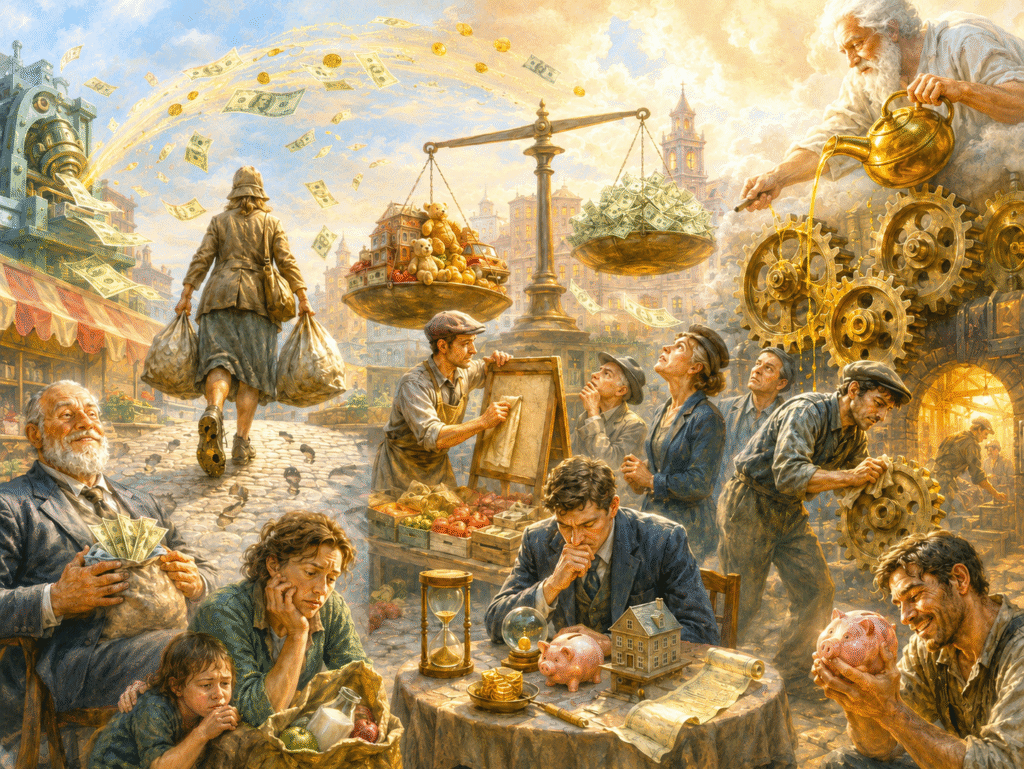

Introduction
Inflation is one of the most important topics in macroeconomics because it affects prices, wages, savings, loans, and the way people make financial decisions. When prices rise over time, money loses purchasing power, meaning the same dollar buys fewer goods and services.
But inflation is not only about higher prices. It is also connected to the money supply, the demand for money, interest rates, expectations about the future, and the behavior of workers, firms, borrowers, and lenders. Understanding these connections helps explain why central banks pay close attention to inflation and why even moderate inflation can create economic costs.
How Money, Prices, and Interest Rates Are Connected
Money, prices, and interest rates are linked through several economic relationships. The basic idea is that the supply of money and the demand for money help determine the price level in the economy. When the money supply grows faster than real output, prices tend to rise.
Money Supply and the Price Level
In the quantity theory of money, an increase in the money supply leads to a proportional increase in the price level, assuming output and velocity are stable. This means that when more money circulates in the economy without a matching increase in goods and services, inflation can occur.
For example, if there is more money available but the same amount of goods, buyers may bid up prices. Over time, this creates a higher overall price level.
The Fisher Effect and Nominal Interest Rates
The Fisher effect explains the relationship between inflation and nominal interest rates. The nominal interest rate includes two parts: the real interest rate and expected inflation.
When people expect higher inflation, lenders demand higher nominal interest rates to protect the real value of their returns. Borrowers then face higher borrowing costs.
In simple terms:
Nominal interest rate = Real interest rate + Expected inflation
This relationship helps explain why countries with higher expected inflation usually have higher nominal interest rates.
Nominal Interest Rates and the Demand for Money
The demand for money is not only influenced by income. It is also affected by the nominal interest rate. People hold money because it is useful for transactions, but holding money has a cost.
The Cost of Holding Money
Money in your wallet or checking account usually earns little or no interest. If you hold money instead of putting it into bonds, savings accounts, or other interest-earning assets, you give up the interest you could have earned.
That lost interest is called the opportunity cost of holding money.
When nominal interest rates are high, holding money becomes more expensive because people give up more potential interest. As a result, people usually try to hold less money and move more of their wealth into interest-bearing assets.
Money Demand and Income
The demand for real money balances depends on two main factors:
Income and nominal interest rates.
When income rises, people make more transactions, so they demand more money. When nominal interest rates rise, people demand less money because holding cash becomes more costly.
This creates an important relationship:
Higher income increases money demand.
Higher nominal interest rates reduce money demand.
Future Money Supply and Current Prices
Inflation is not only shaped by today’s money supply. Expectations about future money growth also matter.
If people believe the central bank will increase the money supply in the future, they may expect higher future inflation. That expectation can raise nominal interest rates today through the Fisher effect.
Higher nominal interest rates increase the cost of holding money, reducing the demand for real money balances. If money demand falls while the current money supply stays the same, the price level can rise immediately.
This means expectations can affect the economy before policy changes actually happen. In macroeconomics, expectations are powerful because people make decisions based not only on current conditions but also on what they believe will happen next.
Why Inflation Is a Social Problem
Many people dislike inflation because they feel it makes them poorer. When prices rise, wages and savings may not seem to keep up. However, economists often argue that the issue is more complex.
If all prices, wages, and incomes rose at exactly the same rate, inflation would mostly change the unit of measurement, similar to changing from feet to inches. The real problem is that inflation does not affect everything equally or instantly.
Inflation creates costs because it changes behavior, distorts prices, complicates planning, and redistributes wealth.
The Costs of Expected Inflation
Expected inflation happens when people correctly anticipate future price increases. Even when inflation is predictable, it can still create economic costs.
Shoeleather Costs
When inflation is high, nominal interest rates tend to rise. Because holding money becomes more costly, people may hold less cash and make more frequent trips to banks or financial accounts.
This inconvenience is called shoeleather cost. The term comes from the idea that people “wear out their shoes” by making extra trips to manage their money.
Today, online banking reduces this cost, but the basic idea remains: inflation encourages people and businesses to spend time and effort avoiding the loss of purchasing power.
Menu Costs
Inflation forces businesses to update prices more often. Restaurants may need to print new menus, stores may need to update labels, and companies may need to revise catalogs or websites.
These are called menu costs.
Even when the physical cost of changing prices is small, the decision process can still be costly. Businesses must monitor costs, competitors, and customer reactions before adjusting prices.
Relative Price Distortions
Inflation can also distort relative prices. If some firms change prices often while others change prices slowly, prices no longer reflect true supply and demand conditions as clearly.
For example, a company that updates its prices once a year may become relatively expensive early in the year and relatively cheap later in the year if inflation is ongoing. This can affect consumer behavior and lead to inefficient allocation of resources.
Tax Distortions
Inflation can create problems in the tax system when tax rules are not fully adjusted for rising prices.
One common example involves capital gains. If someone buys an asset and sells it later for a higher nominal price, part of that gain may simply reflect inflation. However, the tax system may treat the entire nominal gain as taxable income, even if the real gain is small or nonexistent.
This means inflation can cause people to pay taxes on gains that are not truly increases in purchasing power.
Confusion and Planning Problems
Money is the unit used to measure economic value. When the value of money changes constantly, planning becomes harder.
Inflation complicates saving, retirement planning, business investment, wage negotiations, and long-term contracts. People must think not only about dollar amounts but also about what those dollars will be worth in the future.
The Costs of Unexpected Inflation
Unexpected inflation is usually more harmful than expected inflation because people do not have time to adjust contracts, wages, interest rates, or financial plans.
Redistribution Between Borrowers and Lenders
Unexpected inflation changes the real value of debt.
If inflation is higher than expected, borrowers benefit because they repay loans with dollars that are worth less than anticipated. Lenders lose because the money they receive has lower purchasing power.
If inflation is lower than expected, lenders benefit and borrowers lose because repayments are worth more in real terms.
This redistribution can be especially important for long-term loans, such as mortgages, business loans, and government debt.
Harm to People on Fixed Incomes
Unexpected inflation can hurt people who receive fixed payments, such as retirees with fixed pensions or workers with long-term contracts. If their income does not adjust quickly, their purchasing power falls.
This is one reason inflation can create social and political pressure. People may feel that their standard of living is being reduced even if the economy is still growing.
Greater Uncertainty
High inflation is often variable inflation. When inflation changes unpredictably from year to year, households and businesses face more uncertainty.
Uncertainty makes it harder to sign contracts, make investments, save for the future, and plan wages. Because most people dislike uncertainty, variable inflation can reduce economic confidence.
Inflation and Historical Examples
History shows that inflation and deflation can create political and economic conflict.
During periods of deflation, the value of money rises. This can benefit lenders because borrowers repay loans with more valuable money. However, deflation hurts borrowers because their debts become harder to repay in real terms.
In the late nineteenth century, debates over gold, silver, money supply, and deflation became major political issues in the United States. Farmers and debtors often favored policies that would increase the money supply and raise prices, while creditors tended to support policies that preserved the value of money.
This shows that changes in the price level are not neutral for everyone. Inflation and deflation can create winners and losers.
Is There Any Benefit to Inflation?
Although inflation has many costs, some economists argue that a small amount of inflation can have benefits.
One possible benefit is that inflation can help labor markets adjust when nominal wages are rigid. Workers usually dislike wage cuts, and firms are often reluctant to reduce nominal wages directly.
For example, a worker may reject a 2 percent wage cut, even if economic conditions require lower real wages. But if wages stay the same while prices rise by 2 percent, the real wage falls without a direct nominal wage cut.
In this way, moderate inflation can make it easier for real wages to adjust. Some economists describe this as inflation “greasing the wheels” of the labor market.
However, this does not mean high inflation is good. The argument is usually about low and stable inflation, not rapid or unpredictable inflation.
Why Central Banks Aim for Low and Stable Inflation
Central banks usually try to keep inflation low and predictable. The goal is not simply to eliminate all price changes but to avoid the uncertainty and distortions caused by high or unstable inflation.
Low and stable inflation helps:
Businesses plan investments.
Consumers make spending and saving decisions.
Workers negotiate wages.
Lenders and borrowers write contracts.
Governments manage tax and spending policies.
When inflation expectations are stable, the economy can function more smoothly.
Conclusion
Money and inflation are deeply connected to interest rates, money demand, expectations, and economic decision-making. The nominal interest rate matters because it represents the opportunity cost of holding money. When expected inflation rises, nominal interest rates tend to rise as well, reducing money demand and affecting the price level.
Inflation creates several costs, including shoeleather costs, menu costs, tax distortions, relative price distortions, planning difficulties, and wealth redistribution between borrowers and lenders. Unexpected inflation is especially harmful because it changes outcomes after people have already made financial decisions.
At the same time, a small amount of stable inflation may help labor markets adjust when wages are slow to fall. For this reason, many economists support low and predictable inflation rather than zero inflation or high inflation.
Understanding inflation is essential because it affects everyday life, from the money people hold to the wages they earn, the loans they repay, and the prices they face.